


Most tradie businesses don’t stall because the work is poor. They stall because the owner is on the tools all day and the business runs on whatever energy is left at 8 pm. Growth usually comes from fixing a handful of leaks: calls you miss, quotes that go out late, jobs you underprice, and invoices that wait until Sunday night.
This guide walks through seven moves that work for sole traders and small crews across Australia. None of them needs a new office, a bookkeeper or a business degree.
TL;DR
- Speed of response is a growth lever. Nearly half of Australian construction businesses have lost work because they didn’t respond to enquiries quickly enough, not because of price or quality.
- Price every job on full costs, then send the quote the same day, ideally from site.
- Follow up every quote on a set schedule, and send invoices the day the job finishes.
- A simple website, clear service areas and tender-ready paperwork open doors to better customers.
- Use voice tools so admin happens while your hands are busy, not after hours.
Table of Contents
- Why growth looks different for a tradie
- 1. Answer every call, or make sure someone does
- 2. Quote on the day, from site
- 3. Price on full costs, not on gut feel
- 4. Follow up every quote
- 5. Get paid faster
- 6. Look credible before they call
- 7. Go after bigger, steadier work
- What we think: the best growth is the admin you stop doing
- A 30-day plan you can start this week
- Where Ask Hayley fits
- FAQ
- Sources
Why growth looks different for a tradie
You are in a crowded field, and most of it is small. According to the ASBFEO, small businesses make up 97.3% of actively trading businesses in Australia, and 63.6% of those are non-employing. Plenty of your competitors are one person with a ute and a phone.
The industry itself is big. The ABS says construction was 7.0% of Australia’s GDP in 2023-24 and employed around 1.3 million people. There is work out there. The question is who gets it.
When the work is available and the skills are similar, the winner is often the business that picks up, quotes first and looks organised. That is good news. Those are things you can change this month.
1. Answer every call, or make sure someone does
You can’t answer the phone from the roof, under a house or halfway up a ladder. But the customer ringing you is usually ringing three businesses. The first one to respond tends to get the job.
The research here is blunt. Close to half of construction businesses surveyed in the CommBank research reported losing potential work purely through slow responses. That is revenue you earned by being good at your trade and then lost by being unreachable.
You have a few options:
- Voicemail and call back. Free, but slow. Many callers won’t leave a message.
- A part-time receptionist or family member. Reliable, but a fixed cost and limited to their hours.
- An answering service or AI call answering. Picks up when you can’t, takes the details and passes them on.
This is the gap Ask Hayley was built for. Hayley answers inbound calls when you can’t and pre-qualifies leads before they land in your inbox, so you see a real job enquiry, not a pile of missed calls and wrong numbers. You can read about our approach on the Ask Hayley homepage.
What to capture on every call
Whoever answers, whether it’s you, a partner or Hayley, should get the same five things:
- Name and best number
- Suburb or address
- What the job is, in a sentence
- How urgent it is
- Whether it’s a quote, an emergency or a repeat customer
That list is what lets you decide in ten seconds whether to ring back first or finish the job you’re on.
2. Quote on the day, from site
A quote that goes out two days later competes with a quote that went out two hours later. Usually the second one wins.
The usual problem is not that you can’t price. It’s that quoting means going home, opening a laptop, finding last month’s template and typing it up. So it waits until the weekend.
Shorten the chain:
- Take photos and measurements on site.
- Say the scope out loud while you’re still there.
- Turn that into a quote before you leave the driveway.
That is what voice-to-quote is for. We’ve written a walkthrough on how to dictate a voice quote on site in under five minutes, including what to say so the quote comes out clean.
The same logic applies after the yes. A hands-free quote to invoice workflow means the approved quote becomes the job, and the job becomes the invoice, without retyping the same details three times.
3. Price on full costs, not on gut feel
Growth that loses money is just a bigger problem. Before you chase more work, check that the work you already win is paying properly.
The usual traps:
- Pricing materials but not your time spent buying them
- Forgetting travel, tip fees, consumables and equipment wear
- Ignoring insurance, licences and software in your hourly rate
- Leaving no margin for a job that runs over
- Quoting a mate’s rate to a stranger
We’ve listed the five costs Australian tradies should include in every quote. Run your last five jobs through that list. If you find a gap, fixing it is often worth more than a new customer.
For context on the wider picture, the ABS reports median weekly earnings for an Australian employee in their main job were $1,425 in August 2025. That is an employee figure, not a tradie benchmark, but it’s a useful reminder that your rate has to cover things an employee’s wage doesn’t: leave, tools, vehicle, insurance and the unpaid hours of running a business. The same release counts 1.1 million independent contractors, 7.6% of all employed people, so you are far from alone in carrying those costs.
4. Follow up every quote
Most tradies send a quote and wait. Customers get busy, get other quotes and forget. A short, polite follow-up is often what separates a quote that sits from a job that books.
Keep it simple and consistent:
| When | What to send | Goal |
|---|---|---|
| Same day | Quote plus a one-line thanks | Confirm they received it |
| 2 to 3 days later | Short text asking if they have questions | Remove doubts |
| About a week later | Brief check-in with an offer of dates | Move to a booking |
| After that | One last polite note, then let it go | Close the loop |
The exact timing depends on your trade. A blocked drain follows up in hours. A bathroom reno can take weeks. We cover the thinking in our guide on how to set a follow-up cadence.
The point is that the schedule exists. When it lives in your head, it happens when you remember. When it’s set up as a routine, it happens every time.
5. Get paid faster
Cash flow limits growth more than almost anything. You can’t hire an apprentice or buy the next ute if you’re waiting on invoices.
Three habits help:
- Invoice on the day. Send it while the customer is still happy with the work.
- Make it correct. Your ABN, GST treatment and itemised work on the invoice mean fewer queries and fewer delays. Our guide to ABN and GST ready voice to invoice workflows covers what to include.
- Use deposits and progress claims on bigger jobs. Waiting until the end to bill a multi-week job puts all the risk on you.
If your books are in Xero or your jobs run through AroFlo, it matters that your admin tool connects to them rather than creating a second set of records. Ask Hayley integrates with both.
6. Look credible before they call
A customer who has never heard of you will check you out. A simple website with your services, your service areas, your licence details and a clear way to get in touch makes you look like a business, not a number on a sticker.
You don’t need a big site. For most trades, one good page beats five thin ones. Focus on:
- What you do, in plain words
- Where you work, by suburb or region
- Licence and insurance details
- Photos of real jobs
- One obvious way to call or request a quote
We’ve set out three homepage layouts that suit Aussie tradies and how to make service area pages that get calls.
If you’re also putting out social posts or ads, AI tools can speed up the content side. For example, Soclo’s AI video and ad tools let you generate campaign material from plain-English prompts. It’s an option if marketing is the task that never gets done.
7. Go after bigger, steadier work
Residential jobs are the backbone for many trades, but councils, builders, strata managers and commercial clients can bring repeat, higher-value work. They also ask for paperwork: prequalification, methodology statements, safety documents.
That paperwork is where many good tradies lose out. They can do the job, but they can’t show it on paper. Start with these:
- A one-page tender cover letter. See how to win local tenders with a one page cover letter.
- A methodology statement that scores well. Our methodology statement templates show the structure.
- Prequalification. If you’re eligible but not hired, our guide to contractor prequalification in Australia explains where the gaps usually are.
- Safety and compliance paperwork. The CM3 certification guide breaks the process into eight steps.
It’s a slower path than answering the phone faster. But a single good commercial relationship can fill a diary for a year.
What we think: the best growth is the admin you stop doing
We built Ask Hayley because we kept seeing the same pattern. A tradie does a great day’s work, then spends the evening on quotes, invoices and call-backs. The business grows only as far as that evening has hours.
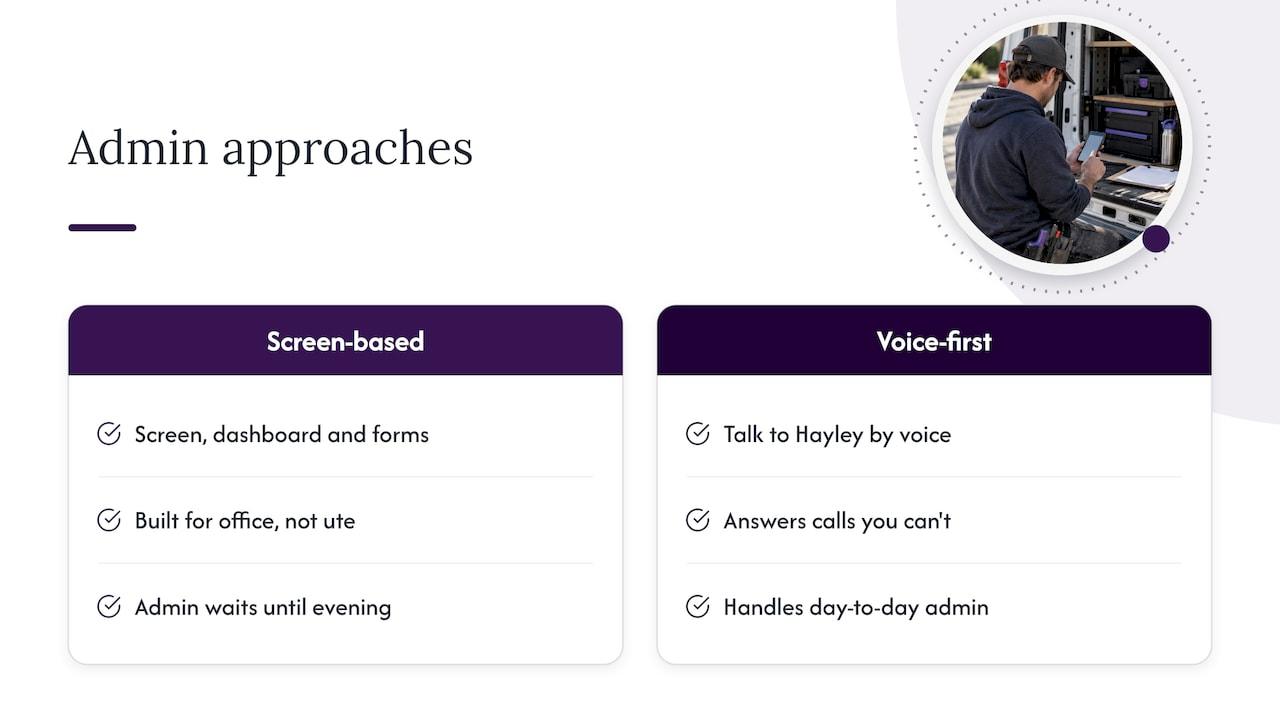
Our view is simple. Software that asks you to sit at a screen, learn a dashboard and type into forms is built for an office, not a ute. If admin takes your hands, it won’t get done on site, so it gets done at night, or not at all.
So we went voice-first. You talk to Hayley the way you’d talk to a good office manager. Hayley answers calls you can’t, screens the enquiries, and handles day-to-day admin from voice prompts. There are two core plans, Assistant and Office Manager, and optional add-ons: an AI Sales Agent and an AI Website Chatbot, for owners who want wider coverage across calls, leads and customer enquiries.
We’re also realistic. New tools only help if you’ll use them. The research suggests the barrier isn’t interest: 80% of small businesses are adopting or planning to adopt AI, yet 70% of owners have had no formal instruction on how to use it. That’s why we aim to avoid another app to learn. Start with one pain point, usually missed calls or late quotes, and add from there.
The early evidence is encouraging, though keep it in proportion. In a 2025 small business survey, 40% of businesses reported higher revenue since implementing AI. That’s a broad small business figure, not a tradie-specific one, and results vary. Across all Australian businesses, ABS data shows 12% reported using AI in 2024-25, up from 1% in 2022-23. Tradies who move now are still early.
— Hayley
A 30-day plan you can start this week
Don’t try all seven at once. Here is a sensible order:
Week 1: Stop the leaks. Decide how every call gets answered. Write down the five things to capture.
Week 2: Speed up quoting. Quote from site on every job. Set a rule: no quote waits more than 24 hours.
Week 3: Fix pricing and follow-up. Rework your rate using full costs. Set your follow-up schedule and stick to it.
Week 4: Look the part. Tidy your website or build a one-pager. List your service areas. Gather your licence, insurance and safety documents in one folder.
After 30 days, check three numbers: how many enquiries you received, how many you quoted, and how many you won. Those three numbers tell you where the next improvement is.

Where Ask Hayley fits
If you want help with the parts above, we offer a few ways in:
- The platform. Voice-first call answering, lead pre-qualification, quotes, invoicing, tasks, calendar and reporting, with Xero and AroFlo integrations. Start at askhayley.com.au.
- One Page Website. A simple, credible site built for trades. See the One Page Website details.
- Tendering. Support to prepare tender responses. See our tendering service.
- Safety and compliance documentation. Paperwork that helps you qualify for more work. See safety and compliance documentation.
Pricing for the website, tendering and compliance work depends on the project, so talk to us about what you need.
FAQ
How do I grow a tradie business without hiring straight away?
Start with the things that cost time, not wages: answering every call, quoting the same day, following up and invoicing promptly. These raise your win rate and cash flow without adding staff. Once your diary is consistently full, you’ll know when a hire makes sense.
What is the biggest reason tradies lose work?
Often it’s speed, not price or skill. In CommBank-backed research, 45% of construction businesses reported losing potential work because they were too slow to respond. Answering calls and sending quotes quickly addresses that directly.
Is AI worth it for a small trade business?
It can be, if it solves a specific problem you already have, like missed calls or after-hours quoting. Start with one task, see whether it saves you time, then expand. Check any tool’s privacy terms and how it connects to your existing accounting software.
Do I need a website to grow my tradie business?
You don’t need a large one, but customers do check. A single clear page with your services, service areas, licence details and contact options is enough for most trades to look credible and get found.
Sources
- CommBank and OpenAI are betting AI can fix the tradie admin problem, Dynamic Business
- Number of small businesses in Australia, ASBFEO
- The nuts and bolts of the Australian Construction industry, ABS
- Characteristics of Employment, Australia, August 2025, ABS
- The Australian Small Business AI Report 2025, BizCover
- State of Small Business Report, COSBOA
- Characteristics of Australian Business, 2024-25, ABS


