


Use progress invoicing on multi-stage jobs: agree stages in the contract, issue tax invoices or payment claims at each stage, and keep on-site evidence to support every claim. This keeps you compliant with ATO GST rules and QBCC guidance on proportionate payments. Tools designed for tradies make it easier to capture claims and admin without sitting at a desk.
TL;DR:
- QBCC guidance generally caps deposits at 20%, except for justified custom work; progress claims must match completed value to avoid insurance and penalty risks.
- The ATO treats each stage as a separate sale for GST, reported when payment arrives or a tax invoice issues, whichever happens first.
- Write stage descriptions, values totaling 100%, completion criteria, and reference dates into the contract; otherwise statutory default dates may apply, often month end.
- Photographs, client approvals, and supplier receipts support claims; capture them as work finishes, because reconstructing evidence can delay invoices by days or weeks.
- Each stage invoice needs your ABN, issue date, work description, GST amount or inclusion statement, and total payable for that stage.
Table of Contents
- What progress invoicing is and why tradies use it
- Australian regulator expectations: deposits, proportional progress payments and contract clauses
- GST and tax invoices for progressive supplies: what you must do for ATO compliance
- Step-by-step setup: agree stages, build the schedule, collect evidence, issue claims
- Worked example: a short sample payment schedule tradies can adapt
- Tools and on-site workflow: capture evidence, link to accounting, reduce admin
- How long progress invoicing takes from contract to final payment
- What progress invoicing costs you in fees, time and cash flow
- Common disputes in progress invoicing and how to avoid them
- A tradie’s take on keeping progress invoicing simple
- Get progress invoicing off your plate with Ask Hayley
- FAQ
- Sources
What progress invoicing is and why tradies use it
Progress invoicing means billing a client in stages as work is completed, rather than waiting until the whole job is finished to send one invoice. Instead of carrying the full cost of materials and labour for weeks or months, you get paid as you go.
It works well for jobs that run long, involve expensive materials upfront, or happen in clear phases, think kitchen renovations, new builds, or multi-room fit-outs. A bathroom reno might have a deposit, a stage for rough-in work, a stage for fit-off, and a final payment at completion.
The benefits are straightforward:
- You pay suppliers and subcontractors without dipping into savings or credit.
- Clients avoid a large lump sum at the end, which makes bigger jobs easier to agree to.
- Cash flow stays steady across a project instead of arriving in one hit at the end.
- Disputes are easier to resolve because each stage has its own evidence and sign-off.
Setting this up properly means getting the legal side right and understanding how GST applies to each stage, both of which we cover next.
Australian regulator expectations: deposits, proportional progress payments and contract clauses
Before you set a payment schedule, it helps to know what regulators expect. The Queensland Building and Construction Commission advises against asking for more than a 20% deposit, unless the job involves special fabrication or custom materials that justify a higher upfront payment. Progress payments after that should be proportionate: you claim for the value of work actually completed, not a round number that suits your cash flow.
The QBCC’s Level 2 contract template includes a condition, often referred to as Condition 19, that warns contractors directly: progress payments must match the value of work at site. Overclaiming isn’t just bad practice, it can reduce your insurance protection and expose you to penalties if a dispute lands with a regulator or adjudicator.
A few habits keep you on the right side of this:
- List each stage in the contract with a clear description of the work it covers.
- Attach a percentage or dollar value to every stage that reflects real effort and materials.
- Set reference dates for each claim so there’s no ambiguity about when payment is due.
To put a schedule together that holds up:
- Break the job into stages that match physical progress (not arbitrary time periods).
- Assign a value to each stage that totals 100% of the contract price.
- Write the stages and values into the contract before work starts.
- Confirm reference dates with the client in writing.
If a contract is silent on reference dates, the QBCC’s security of payment guide notes that statutory default dates, often the last day of the month, apply automatically. It’s simpler to set your own dates than rely on a default you haven’t checked.
GST and tax invoices for progressive supplies: what you must do for ATO compliance
GST on staged work isn’t optional extra admin, it’s a reporting requirement. The Australian Taxation Office treats each progressive component of a job as a separate sale for GST purposes. You report GST in the period you receive payment or issue a tax invoice, whichever happens first, not when the whole project wraps up.
If you use non-cash (accrual) accounting, Division 156 attribution rules affect how progress payments land in your reporting periods, so it’s worth checking how your accounting method interacts with staged billing before you lock in a schedule.
Every tax invoice you issue for a stage needs to include:
- Your ABN and business name.
- The date of issue.
- A clear description of the work covered by that stage.
- The GST amount, or a statement that the total includes GST.
- The total amount payable for that stage.
A single document can cover multiple stages or components, as long as it shows each component’s price clearly enough that the client can work out what they’re paying for and what GST applies to each part.
Step-by-step setup: agree stages, build the schedule, collect evidence, issue claims
Getting progress invoicing right comes down to sequence. Skip a step and you’ll end up chasing payment or arguing over what’s owed.
- Agree the payment schedule in the contract. Include the deposit amount, each stage, retention terms, and reference dates before work starts.
- Build a schedule of values. List every stage with a dollar figure or percentage, and make sure they total 100% of the contract price.
- Decide your retention policy. Note how much you’ll hold back (if any) and when it’s released, usually at practical completion or after a defect liability period.
- Capture evidence on site. Photos, client sign-offs and supplier invoices for materials used in that stage all support your claim if it’s ever questioned.
- Issue the tax invoice or payment claim correctly. Match it to the contract stage, include all required GST details, and keep records for your own reporting and in case of adjudication.
- Follow a simple chase cadence. Send a polite reminder a few days after the due date, then escalate to a formal payment claim under security of payment legislation if it’s still unpaid after a week or two.
Pro Tip: Take photos of completed work before you leave site each day, not just at the end of a stage. It’s much easier to have evidence ready than to reconstruct it later.
Worked example: a short sample payment schedule tradies can adapt
Here’s a simple structure for a renovation worth, say, $40,000 in total:
- Deposit: 10% ($4,000) on signing, covering initial materials and scheduling, with options to take deposits online to simplify upfront payments.
- Stage 1, rough-in: 30% cumulative ($12,000 billed) once framing and services are roughed in.
- Stage 2, fit-off: 70% cumulative ($28,000 billed) once fixtures, cabinetry and finishes are installed.
- Practical completion: 95% cumulative ($38,000 billed) once the client has inspected and signed off.
- Retention release: 100% ($40,000 billed) after the defect liability period, often 90 days.
For smaller jobs, say a $5,000 bathroom repair, you might collapse this into just a deposit and a final payment. For a larger renovation, you’d add more stages so no single claim represents too much uninspected work.
Attach your evidence, photos, sign-offs, supplier receipts, to each stage’s invoice, and show the cumulative total billed so far alongside the amount currently due. That makes it easy for a client to see exactly where the project sits financially.
Tools and on-site workflow: capture evidence, link to accounting, reduce admin
Progress invoicing only works if the admin keeps up with the job. A few tool categories make that realistic:
- On-site evidence capture (photos, notes, sign-offs tied to a job).
- Job and stage tracking so you know what’s been billed and what’s left.
- Accounting sync with platforms like Xero or MYOB so GST reports correctly.
- Voice-first intake for logging progress without stopping to type.
Getting invoices to map correctly to your Xero accounts matters for GST reporting, mismatched categories cause headaches at BAS time.
This is where Ask Hayley fits the way tradies actually work. Voice intake lets you log a completed stage from your ute, call handling means you’re not missing new enquiries while you’re on a roof, and the quote-to-invoice flow connects to Xero so each progress claim lands in the right place.
Pro Tip: Use a photo plus a quick voice note straight after finishing a stage. It takes ten seconds and gives you a ready-made record for the invoice later.
How long progress invoicing takes from contract to final payment
The timeline depends on the size of the job, but most trade projects follow a similar rhythm. A deposit is typically invoiced and paid within a few days of signing, since it’s due before work starts. Each subsequent stage is usually invoiced within a day or two. of completing the milestone, assuming your evidence capture is already in order.
Payment terms then determine how long you wait for funds to land, commonly 7 to 14 days per stage under standard trade contracts. For a renovation with four or five stages, that means the full invoicing cycle, from deposit to final retention release, can stretch across the entire project length, which might be anywhere from a few weeks for a small job to several months for a larger build.
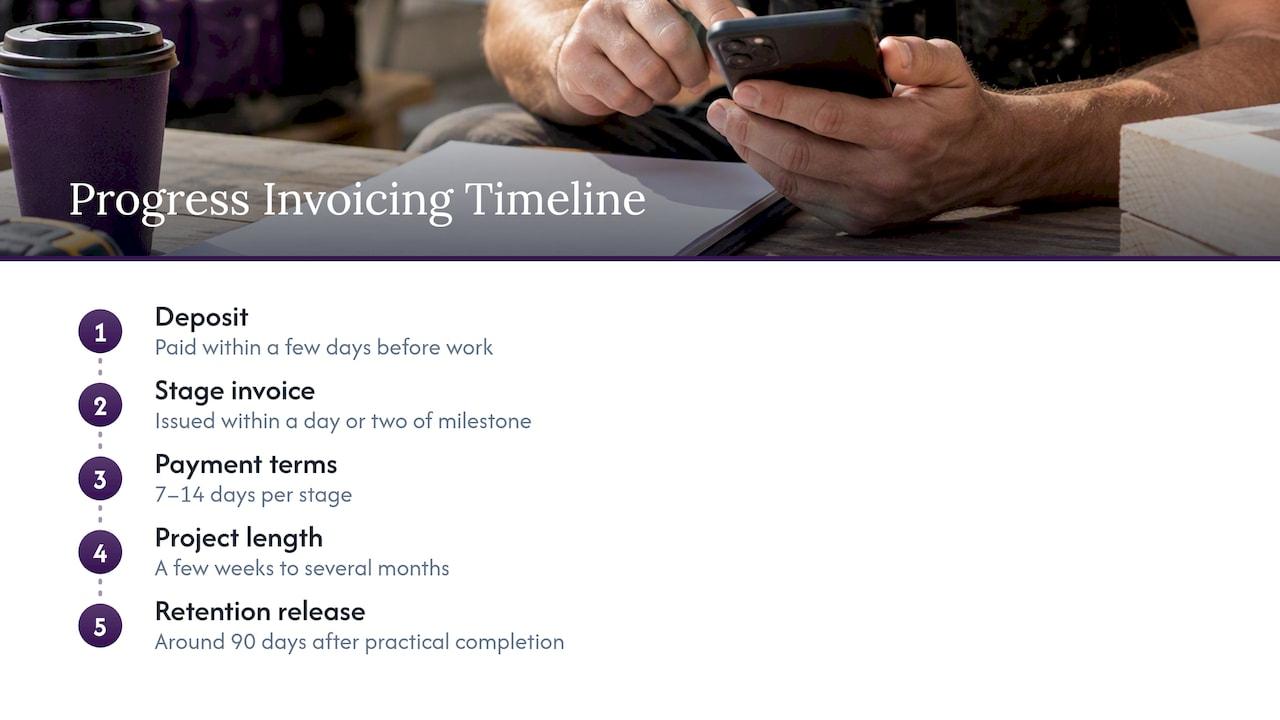
The retention period adds extra time at the end. Many contracts hold back a small percentage until a defect liability period finishes, often around 90 days after practical completion. That final payment doesn’t arrive until that window closes and the client confirms there are no outstanding issues.
The part you control is the gap between finishing a stage and issuing the invoice. Jobs where photos, sign-offs and supplier invoices are captured as the work happens tend to get claims out the same day. Jobs where evidence is gathered after the fact, digging through old photos, chasing a client for a sign-off, routinely add days or weeks to the cycle before you’ve even sent the invoice.
What progress invoicing costs you in fees, time and cash flow
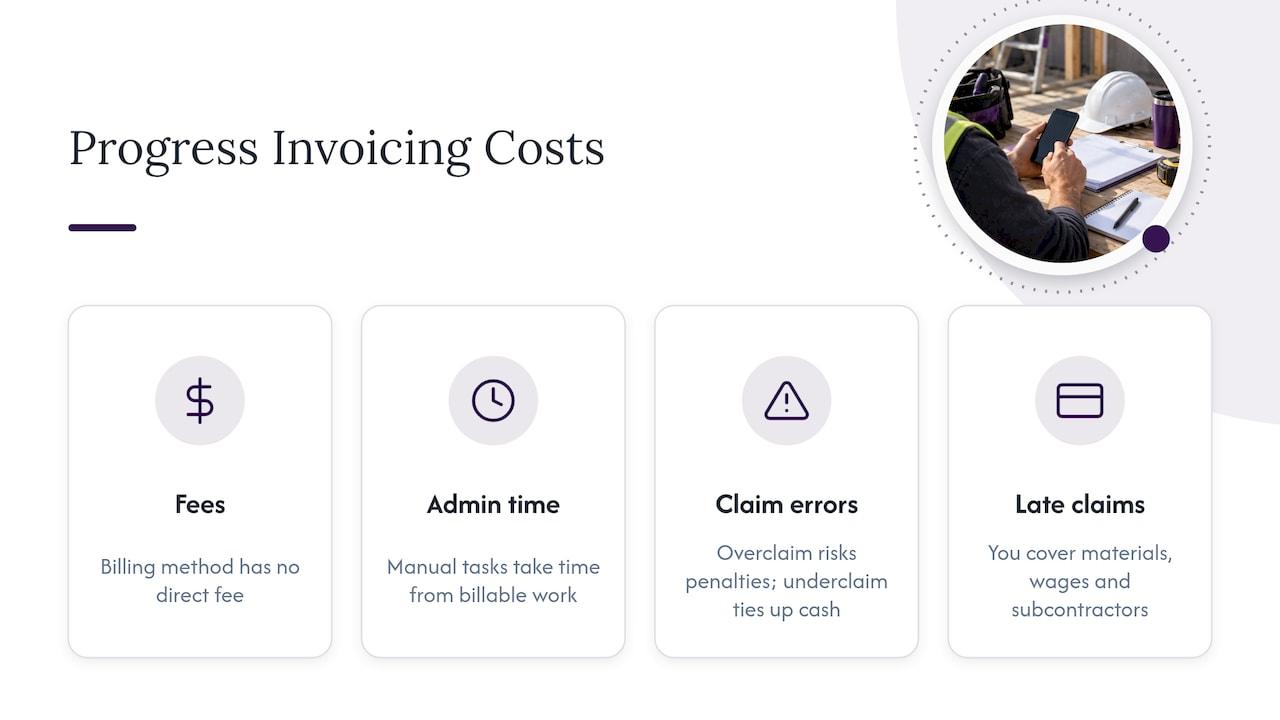
Progress invoicing itself doesn’t carry a direct fee, it’s a billing method, not a paid service. The real costs show up in administration time and the financial risk of getting it wrong.
Administration time is the biggest ongoing cost. Building a schedule of values, capturing evidence for each stage, issuing correctly formatted tax invoices and reconciling payments against your accounting software all take time away from billable work. For a sole trader running several jobs at once, this can add up to a meaningful chunk of a week if it’s done manually.
There’s also a financial risk tied to getting the proportionality wrong. If you claim more than the work completed is worth, as the QBCC notes, you risk reduced insurance protection and potential penalties. Underclaiming, on the other hand, means you’re effectively financing the client’s project with your own cash, the opposite of what progress invoicing is meant to achieve.
Late or unpaid claims carry their own cost too. Every week a progress payment sits unpaid is a week you’re covering materials, wages or subcontractor invoices out of pocket. This is why a clear chase cadence and well-documented claims matter as much as the schedule itself, they shorten the gap between finishing work and getting paid for it.
Software that automates invoice drafting and payment reminders reduces the administration cost, but the time saved is worth weighing against what manual processing currently costs you in hours each week.
Common disputes in progress invoicing and how to avoid them
Most disputes over progress payments come down to one thing: disagreement about how much work has actually been completed. A client might think a stage is 50% done; you might have it at 80%. Without a clear schedule of values and photographic evidence, that disagreement has nowhere to go but back and forth.
Vague stage descriptions cause similar problems. A contract that says “stage 2 payment on fit-off” without defining what fit-off includes leaves room for argument. Spelling out exactly what triggers each payment, specific fixtures installed, specific inspections passed, removes most of that ambiguity before it starts.
Reference dates are another common flashpoint. If a contract doesn’t set them clearly, the QBCC’s security of payment guide explains that statutory defaults apply, which can catch both parties off guard if they haven’t checked what those defaults are.
A few practices head off most disputes before they start:
- Define each stage’s completion criteria in plain language in the contract.
- Attach photos and client sign-offs to every claim as you issue it.
- Set reference dates explicitly rather than relying on statutory defaults.
- Communicate early if a stage is delayed, rather than letting an invoice go out late with no explanation.
When a dispute does happen despite your best efforts, having evidence already attached to the original claim means you’re arguing from a position of record, not memory.
A tradie’s take on keeping progress invoicing simple
Most tradies don’t have spare time between jobs to sit down and build invoices from scratch. Screens and spreadsheets compete with a packed day on site. The businesses that handle progress invoicing well aren’t the ones with the fanciest software, they’re the ones who capture proof the moment work finishes, so the invoice basically writes itself later.
Clear stages and quick evidence protect your margin and get you paid faster. For more detail on building a claim that holds up, our guide on progress claims in Australia goes deeper into the paperwork side.
— Hayley
Get progress invoicing off your plate with Ask Hayley
We built our platform around how tradies actually work: hands full, phone ringing, no time to sit at a laptop. Voice intake lets you log a finished stage on the drive home, and integrations keep your GST reporting accurate without extra data entry.

If chasing paperwork is eating into billable hours, visit Ask Hayley to see how voice-first admin fits around your next job.
FAQ
What is the best invoice app for tradesmen in Australia?
The right invoicing app depends on how much time you want to spend on admin versus on the tools. Apps built specifically for trades, with features like job-stage tracking, photo evidence capture and accounting sync, tend to suit tradies better than generic invoicing software, and voice-first options can reduce screen time on site.
What does progress invoicing mean?
Progress invoicing means billing a client in stages as work is completed, rather than issuing one invoice at the end of a project. Each stage is typically tied to a percentage or dollar value of the total contract and supported by evidence such as photos or client sign-offs, as described by Investopedia.
What are the legal requirements for invoices in Australia?
A compliant tax invoice must show your ABN, the issue date, a description of the goods or services, the GST amount or a statement that GST is included, and the total payable, under ATO rules for progressive sales. For construction work, contracts should also meet state based security of payment requirements covering payment claims and reference dates.
How to do progress billing?
Start by agreeing payment stages and reference dates in the contract, then build a schedule of values that totals 100% of the job price. Issue a tax invoice at each stage with supporting evidence like photos or sign-offs, and follow the QBCC’s guidance on proportionate progress payments to keep claims matched to completed work.


