


Field service dispatch is the job of getting the right person to the right job at the right time, with everything they need to finish it. For a tradie with a small crew, it starts the moment a call comes in, not when someone opens a schedule. The best dispatch routine is simple, runs from one place, and doesn’t depend on you being at a desk. That is why we built Ask Hayley to work by voice: she answers calls you can’t take and handles admin from what you say, so dispatch doesn’t wait until you’re back at the ute.
This guide is for sparkies, plumbers, roofers, arborists, HVAC and air con techs, builders, concretors, cleaners and every other trade or service business that sends people out to customers. You’ll get a plain explanation of what dispatch is, the steps that matter, where jobs go wrong, and how to set up a routine that fits a small team.
TL;DR
- Dispatch is more than assigning a job. It covers capturing the enquiry, checking the job is ready, choosing the right worker, and confirming with the customer.
- Check every job for skill, licence, location, urgency and parts before it goes to a worker. The nearest person is not always the right one.
- Keep one list, and give one named person the job of allocating work each day, even if that person is you.
- Missed calls are where dispatch breaks first. Answering and qualifying enquiries quickly keeps the pipeline full.
- A voice-first tool lets you dispatch and manage admin from site without typing.
Table of Contents
- What field service dispatch actually means
- Why dispatch matters more for a small crew
- The five steps of a solid dispatch routine
- A worked example: a Tuesday for a four-person plumbing crew
- Common dispatch mistakes in the trades
- What to look for in dispatch tools
- Where Ask Hayley fits
- Building the routine in your first week
- Dispatch for different trades
- Our perspective
- FAQ
- Sources
What field service dispatch actually means
In the field service world, dispatch is the process of assigning, scheduling and managing technicians so that service jobs get done. Big companies have a dedicated dispatcher sitting in front of a map. In a trade business of one to fifteen people, the dispatcher is usually the owner, a partner, an office admin or whoever grabs the phone.
The label doesn’t matter. The work does. Every job that comes in has to go through the same questions:
- What does the customer need, and where?
- Is it urgent, or can it wait for a block of work in that area?
- Who is qualified, licensed and free to do it?
- Do they have what they need (parts, access details, a clear scope)?
- Does the customer know who’s coming and when?
If you answer those five questions well, you are dispatching well. If you answer them on the fly between jobs, with notes on your hand or in a text thread, jobs get double-booked, the wrong person turns up, and the customer rings back asking where you are.
Why dispatch matters more for a small crew
When you have a handful of people, one bad dispatch decision is expensive. A tech drives across town to a job they can’t finish. A second visit is needed because a part wasn’t on the truck. A call goes to voicemail and the customer rings the next business on Google.
Research on field service backs up the importance of getting this right the first time. A peer-reviewed Southern Methodist University study of first-time completion in a service environment (it looked at forklift servicing, but the logic carries across trades) found that parts availability, technician experience and anticipating service demand all affect whether a job is finished on the first visit. All three are decided before anyone leaves the yard, which means they are dispatch decisions.
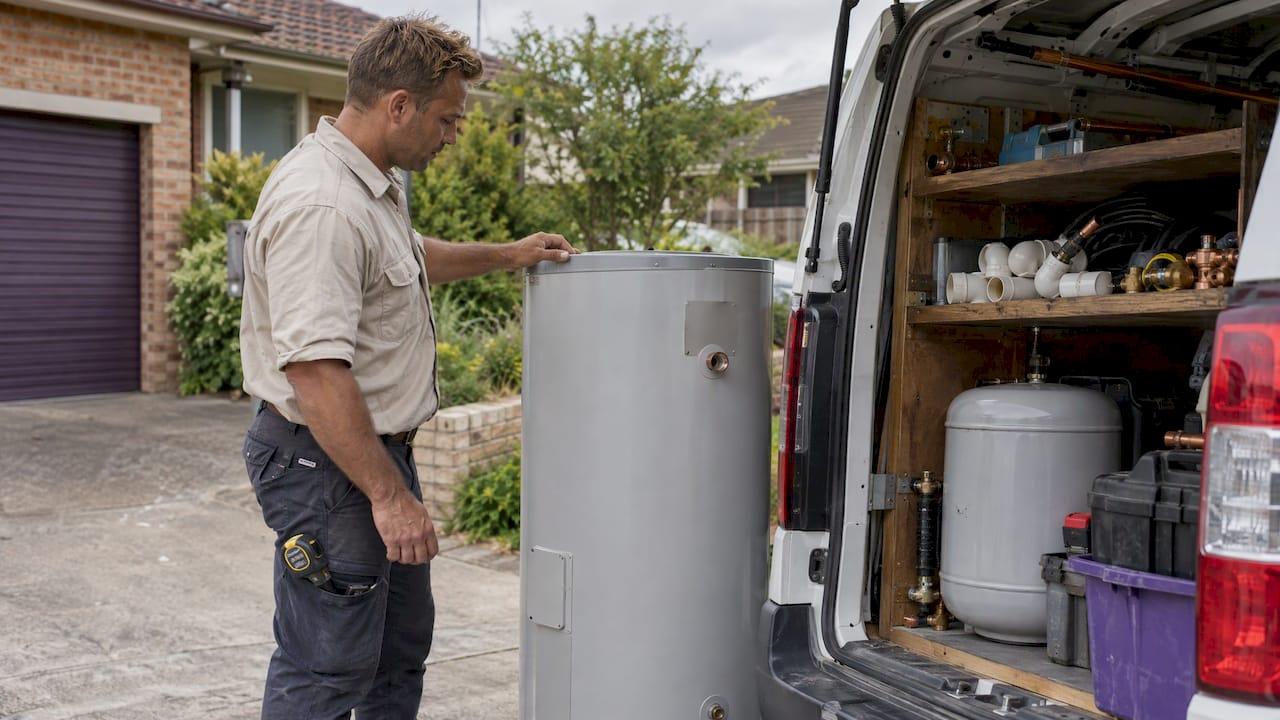
First-visit completion matters in the trades because a return trip costs you travel time, fuel and a slot you could have sold to someone else.
The five steps of a solid dispatch routine
1. Capture the enquiry properly
Dispatch starts with the call or message. If the details are thin, everything after is guesswork. A good intake captures:
- Name, phone number and site address
- What the problem or job is, in the customer’s words
- How urgent it is (water through the ceiling is not the same as a quote for a deck)
- Access details such as gate codes, pets, strata or tenant contact
- Photos if the job is hard to describe
The trouble is that you’re often on a roof, under a house or up a tree when the phone rings. Tradies know the pattern: you finish the job, check your phone, and find three missed calls and no way of knowing which was a real job.
This is where Hayley comes in. She answers inbound calls when you can’t and pre-qualifies leads before they land in your inbox, so what reaches you is a lead with details rather than a bare missed-call notification. That is the front end of dispatch handled while your hands are full.
2. Check the job is ready before you assign it
This is the step most small businesses skip. Australian consultants who write about dispatch make the same point: a surprising amount of scheduling chaos comes from sending out work that isn’t actually ready, where the scope, address, access or parts are still unclear.
A simple readiness check before assigning:
- Scope confirmed. You know what the job involves, or you’ve booked an assessment visit instead of a fix.
- Address and access sorted. Someone can let you in, or you have the key or code.
- Parts and materials known. Nothing critical is on back-order, and the truck is stocked.
- Customer approved the price or the call-out terms. No surprises on the doorstep.
The Southern Methodist University researchers describe the same discipline: dispatchers should identify the service requirements, assess whether a site visit is needed, document the requirements and then assign a technician with suitable skills and available parts. In a trade business that can mean sending a quick photo request to the customer first, or booking a short inspection before the full job.
If you want help working out how your own team handles technology and workflow today, an AI readiness assessment for Australian businesses can map how your staff currently use tools and where the gaps are.
3. Match the job to the right person
The instinct is to send whoever is closest. Sometimes that’s right. Often it isn’t. Before you pick, check:
- Licence and ticket. Electrical work needs a licensed electrician. Refrigerant handling needs the right licence. Working at heights, asbestos, gas fitting and confined spaces each have their own requirements. Check your state or territory regulator for what applies to the work.
- Skill and experience. An apprentice can do plenty, but not every job.
- Location and travel time. Group jobs by suburb where you can.
- Workload. A tech with a full day of back-to-back jobs shouldn’t get an extra “quick one” at 3 pm.
- Urgency. Urgent jobs go to the nearest suitable person. Routine work gets scheduled in area blocks.
The key phrase is “nearest suitable person”. Proximity only wins after licence, skill, readiness and priority checks are passed.
4. Put it in one schedule everyone can see
A job that lives in a text message isn’t dispatched, it’s mentioned. Every job needs one home, whether that’s your calendar, a job list or a work order. Your whole crew should be able to see where they’re going tomorrow without ringing you.
You have a few ways to do this, and we’ve written about them:
- Hands-free job scheduling practices covers habits that keep a schedule tidy when you can’t type.
- Voice job scheduling explains how booking by talking works in practice.
- If your team already lives in Google Calendar, one work calendar with fewer clashes shows how to keep it clean.
Whichever you pick, name one person as the daily allocator. When everyone can add jobs and nobody owns the list, the schedule fills with clashes.
5. Confirm with the customer and track the job to completion
The job isn’t dispatched until the customer knows who is coming, roughly when, and how to reach you. A short text the day before cuts no-shows and gives people a chance to reschedule early. Our guide to SMS appointment reminders walks through what to include.
After the visit, close the loop. Mark it done, record what was used, and send the invoice while the job is fresh. If the job needs a follow-up or a second visit, make that a new job with its own readiness check rather than a note in the margin. For keeping each job moving from start to finish, see work order tracking.
A worked example: a Tuesday for a four-person plumbing crew
Here’s how the routine plays out for a hypothetical plumbing business with a licensed plumber, two plumbers and an apprentice.
At 7:10 am a customer rings about a leaking hot water system. The owner is already on a job, so the call is answered, the address and details are taken, and the lead is marked urgent.
At the morning check, the allocator looks at the list. The hot water job is urgent, and the plumber finishing a job two suburbs away has the right licence and a replacement unit on the truck. That plumber gets it. The apprentice is paired with the other plumber for a routine tap replacement and a drain inspection in the same suburb, booked back to back.
A third enquiry is for a bathroom renovation quote. It isn’t ready to dispatch: nobody has the scope or photos. The allocator sends a photo request and books a 20-minute site visit for Thursday instead of sending a plumber blind.
By 9 am every worker has their jobs, every customer has a confirmation, and nobody has rung the owner to ask “where am I going?”. That is dispatch working. None of it needed a big system. It needed a consistent routine and one list.
Common dispatch mistakes in the trades
Dispatching incomplete jobs. The job lands on someone’s phone with half an address and no scope. They spend the first twenty minutes on the phone to the customer.
Letting the loudest customer jump the queue. Urgency should be defined by the job, not by who rings back three times.
Scheduling by gut with no travel buffer. Back-to-back bookings across suburbs don’t allow for traffic or a job that runs over. Add buffer time between sites.
Treating every job as the same length. A quote visit is not a switchboard replacement. Estimate duration per job type and use your past jobs to improve the guess.
Splitting information across channels. Notes in a notebook, photos in messages, bookings in a calendar and invoices somewhere else means every job requires detective work.
Not measuring anything. If you don’t know how many hours of the week are billable, you can’t tell whether your dispatch is good. Our guides to field service KPIs and utilisation rate calculation show what to track and how to work it out.
What to look for in dispatch tools
Software for dispatch ranges from simple calendars to full field service platforms. When you’re choosing, judge by what your trade actually needs:
| What you need | What to look for |
|---|---|
| Never missing an enquiry | Call answering and lead capture that works while you’re on the tools |
| A single list of jobs | A schedule and task list your whole team can see |
| Right person, right job | Notes on skills, licences and workload when allocating |
| Customer confidence | Reminders and confirmations sent without chasing |
| Getting paid | Quotes and invoicing linked to the job |
| Staying compliant | Compliance and safety records stored with the work |
| No extra learning curve | An interface you can use with your hands full |
The last row is the one most tradies underrate. A tool built for an office dispatcher with two monitors rarely fits a crew member under a sink. If it needs typing, tapping through menus and logging in at every stage, it will fall out of use within weeks, and the dispatch routine falls with it.
Where Ask Hayley fits
Ask Hayley is a voice-first, AI-powered business management platform designed for Australian tradies and small service businesses. Instead of forms and dashboards, you talk to Hayley. She answers inbound calls when you can’t, pre-qualifies leads before they reach your inbox, and handles day-to-day admin through natural voice prompts.
The platform covers the working parts of a dispatch routine: lead capture, call answering, quote generation, invoicing, task management, a calendar, compliance tracking and reporting. It integrates with Xero and other tools you may already use, so you don’t need to rebuild your accounting setup to get started.
There are two core plans, Assistant and Office Manager, plus optional add-ons: an AI Sales Agent and an AI Website Chatbot for broader coverage across calls, leads and customer enquiries.
If missed calls and scattered admin are what slow your dispatch down, you can see how it works at Ask Hayley.

If you also want a professional front door for the enquiries Hayley captures, we build a one page website for trade businesses, and we also prepare tender documents and safety and compliance documentation for businesses chasing larger work.
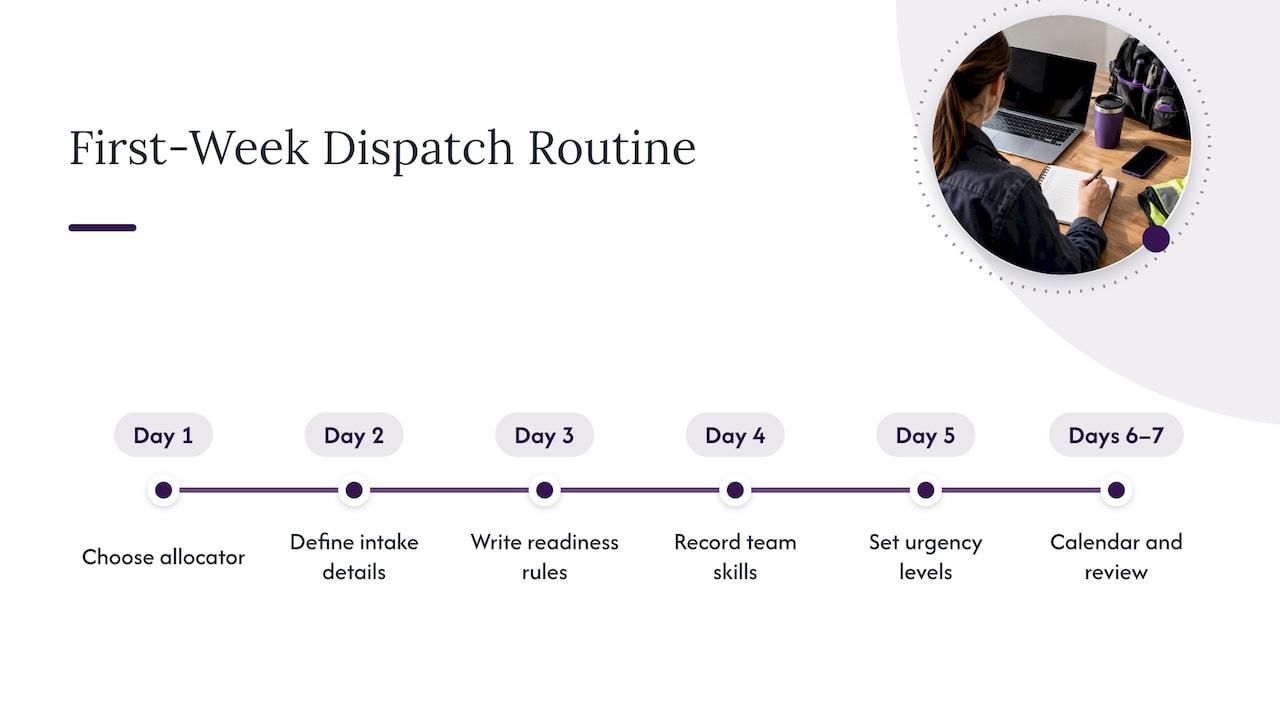
Building the routine in your first week
You don’t need to change everything at once. Here is a sequence that works for a small crew.
Day 1: Decide who allocates. Pick one person to own the daily job list. Write down who covers when they’re away.
Day 2: Define your intake. List the five or six details you need on every enquiry. Use that list for every call, whether you answer it or someone else does.
Day 3: Write your readiness rules. Three or four lines: what has to be true before a job is assigned. Pin it where the allocator will see it.
Day 4: Record who can do what. A one-page list of licences, tickets and strengths per person. Update it when someone gets a new ticket.
Day 5: Set urgency levels. For example: emergency (same day), priority (within 48 hours), routine (scheduled by area). Be specific for your trade, since a blocked drain and a leaking roof have different clocks.
Day 6: Move everything into one calendar or job list. No more jobs in texts only.
Day 7: Review. What jobs went wrong this week? Which ones had a gap at intake, readiness, matching or confirmation? Fix the gap, not the person.
Repeat the review weekly. Over a month you will see patterns, such as the same type of job running over its estimate, or a suburb that always eats your afternoon.
Dispatch for different trades
The five steps apply across the board, but the weight of each step shifts by trade.
- Electricians, plumbers, HVAC and gas fitters: licence matching and emergency response dominate. Keep a clear after-hours roster.
- Roofers, solar installers and gutter cleaners: weather and safe access change the schedule. Build a rain-day plan so jobs can be swapped quickly.
- Arborists and fencing contractors: site assessment first, often with equipment that needs more than one person. Confirm crew size at readiness check.
- Cleaners, pool maintenance and irrigation: recurring routes. Dispatch is about holding a repeatable schedule and covering absences.
- Builders, carpenters, concretors and tilers: long jobs with sequences and trades depending on each other. Dispatch is about order of work and materials on time.
- Removalists: crew size, truck capacity and access details such as stairs and parking decide whether a job is ready.
- Painters, glaziers, waterproofers and garage door repair: measure and quote visits, followed by a second booking for the work. Treat these as two jobs.
Our perspective
Most tradies don’t have a dispatch problem. They have a phone problem and a paperwork problem that shows up as a dispatch problem.
The call comes in while you’re on a ladder. The details end up in a text, a notebook or your head. By the time you work out who should go and when, the customer has called someone else, or the job is double-booked.
We built Ask Hayley around that reality. You shouldn’t have to sit down at a screen to run your business. If you can talk, you can capture a lead, book a job, raise a quote or chase an invoice. Hayley answers the calls you can’t, qualifies the lead before it hits your inbox, and keeps the admin moving from what you say.
Good dispatch comes from good information arriving early and a routine you stick to. Our job is to take the missed calls and the typing off your plate, so the routine survives a busy week.
Hayley
FAQ
What is the difference between dispatch and scheduling?
Scheduling decides when a job happens. Dispatch decides who does it and makes sure they have what they need to complete it. In a small trade business the two usually happen together, but treating them as separate questions helps: a job can be booked for Tuesday and still be undispatched until someone with the right licence and parts is assigned.
Do I need a dedicated dispatcher?
Not in a small team. You need one named person who owns the daily allocation, and that can be you, a partner or an admin. What matters is that one person decides, from one list, using the same checks every time. As you grow past a handful of crews, a dedicated role starts to pay for itself.
Is the nearest worker always the best choice?
No. The nearest worker is only the best choice once licence, skill, job readiness and urgency checks are satisfied. Sending a closer worker who isn’t licensed or doesn’t have the parts costs you a second visit.
How does voice dispatch work on site?
Instead of opening an app and typing, you speak to Hayley to add a job, check your day or handle admin. She also answers calls you can’t take and passes through leads with details. That keeps your hands free and the job list current without a trip back to a desk.
Sources
- Analysis of First-Time Completion in the Field Service Environment, Southern Methodist University
- How to Assign Jobs to the Nearest Available Technician, 5M Consulting
- AI Readiness by Industry for AU and NZ Businesses


