


Quality assurance on calls means checking how your business handles customer calls against a standard you set, then fixing what falls short. For a tradie, that standard is simple: every enquiry is answered or returned quickly, the right details are captured, the caller knows what happens next, and any recording follows Australian law. We built Ask Hayley so the first part of that, getting the call answered and the lead qualified, doesn’t depend on you having a free hand.
Most advice on this topic is written for big call centres with teams of agents and scoring software. You probably have one phone, maybe an office person, and a ute full of tools. This guide strips QA back to what works at that size.
TL;DR
- Call QA is checking calls against a short, written standard, then coaching or fixing the process. You can start with five questions and ten calls a week.
- Split your checks into must-happen items (name, address, job type, callback number, recording notice) and quality items (tone, listening, clear next step).
- Track three or four numbers only: calls answered, time to call back, enquiries that became quotes, quotes that became jobs.
- Recording rules differ by state and territory. Tell callers at the start of the call that it’s recorded, and don’t guess on consent.
- Ask Hayley answers inbound calls when you can’t and pre-qualifies leads before they reach your inbox, so every enquiry starts from the same checklist.
Table of Contents
- What quality assurance calls actually mean for a trade business
- Build your call standard in five questions
- How to review calls without losing your weekend
- Numbers worth tracking (and ones to ignore)
- The follow-up is part of the call
- Recording calls: what Australian tradies need to know
- Where the real quality gap sits: calls you can’t answer
- Perspective: what we think about call QA for tradies
- Setting a standard when someone else answers
- Where Ask Hayley fits
- A simple 4-week plan to start
- FAQ
- Sources
What quality assurance calls actually mean for a trade business
The Australian Customer Experience Professionals Association (ACXPA) defines call centre quality assurance as the systematic process of evaluating customer interactions against defined quality standards, giving feedback, and using the data to keep improving. Strip out the call centre language and that’s three jobs:
- Decide what a good call sounds like.
- Listen to a sample of real calls and compare them to that standard.
- Fix the gaps, whether that’s a habit, a script or a missed-call problem.
For a plumber, sparky or arborist, the “agent” is usually you, your partner or whoever picks up the phone at the office. The calls are enquiries, quote follow-ups, booking changes and the occasional angry customer. The stakes are real: every poorly handled call is a job that goes to the next name in the search results.
QA is not the same as call monitoring
Monitoring is listening. QA is listening against a standard and then doing something about it. If you listen to a recording and think “that was a bit rough” but change nothing, that’s not QA. If you score ten calls, notice that you forget to ask for the suburb on half of them, and add it to your opening questions, that is.
Build your call standard in five questions
You don’t need a 40-line scorecard. ACXPA’s guide splits criteria into two types, and that split works well for a small business:
- Compliance items: things that must happen on every call with no exceptions, scored simply pass or fail.
- Quality items: things like rapport, active listening, empathy and resolving the issue, where performance sits on a range and separates good from great.
Here’s how that looks for a trade business.
Must-happen items (pass or fail)
| Check | Why it matters |
|---|---|
| Caller’s name and best callback number captured | Without it, you can’t follow up |
| Job address or suburb captured | You can’t quote or schedule without it |
| Type of work and urgency captured | Decides whether it’s an emergency, a quote or a booking |
| Recording notice given at the start (if you record) | Keeps you on the right side of the law |
| Next step stated (“We’ll call you back by 3 pm”) | Stops the caller ringing around |
Quality items (score 1 to 3)
- Greeting: business name, your name, calm and clear, even with a saw going in the background.
- Listening: you let them describe the problem before jumping to price.
- Clarity: you explained the process in plain words, with no trade jargon.
- Tone: friendly and confident, not rushed.
- Close: the caller hung up knowing exactly what happens next.
Print it on one page. Five must-haves, five quality items. That’s your scorecard.
How to review calls without losing your weekend
The biggest QA mistake in small businesses is aiming for a perfect system, then never doing it. Keep the routine small enough that you’ll actually do it.
A 30-minute weekly routine
- Pull ten calls. Mix answered calls, calls from a team member and at least two that turned into nothing. If you don’t record, use your call log and your notes.
- Score each call against the scorecard. Pass or fail on the must-haves, 1 to 3 on the quality items.
- Spot the pattern. One bad call is bad luck. The same miss on four calls is a process problem.
- Pick one fix. One change per week: a new opening question, a better voicemail message, a faster callback window.
- Share it. If you have an office person or apprentice answering, give feedback on the specific moment in the call, not their general attitude.
Review the calls you didn’t answer
This is where trade businesses differ most from call centres. In a call centre, every call gets answered. In your business, the biggest quality gap is often the call that went to voicemail while you were up a ladder or under a house.
So add a section to your review: how many calls rang out or hit voicemail, how many left a message, and how long it took to get back to them. A good voicemail helps here. Our out of office voicemail scripts for tradies show what to say so callers leave the details you need.
Numbers worth tracking (and ones to ignore)
Call centre guides list dozens of metrics. For a trade business, four tell you nearly everything:
| Measure | How to work it out | What it tells you |
|---|---|---|
| Answer rate | Calls answered ÷ total inbound calls | How many enquiries you’re even getting to talk to |
| Callback time | Time from missed call to your return call | Whether you’re winning the race against other businesses |
| Enquiry-to-quote rate | Quotes sent ÷ enquiries | Whether calls are being qualified properly |
| Quote-to-job rate | Jobs won ÷ quotes sent | Whether pricing and follow-up are working |
A worked example. Say you get 40 inbound calls in a week and answer 28. Your answer rate is 70%. Of the 12 you missed, 5 left a message and you called them back the same day. Of 33 total contacts, you send 18 quotes and win 7 jobs. Your quote-to-job rate is about 39%. The weak spot isn’t your pricing. It’s the 7 missed callers who never left a message and never heard from you. That’s where the next improvement is.
Ignore anything that needs a data analyst: sentiment scores, long lists of keywords, average handle time to the second. They matter in a 200-seat call centre. They don’t help you book more jobs. If you want a broader set of business measures, our guide to field service KPIs covers the ones that suit a trade business.
The follow-up is part of the call
A call isn’t finished when you hang up. A quote request that gets no reply for three days is a quality failure even if the call itself was perfect. Build the follow-up into your standard: a text after the call, a quote within a set number of days, and a second contact if there’s no reply. Our guide to a follow-up cadence lays out a simple schedule, and SMS appointment reminders help cut no-shows once the job is booked.
Recording calls: what Australian tradies need to know
Recording makes QA much easier, because you can listen back instead of relying on memory. It also brings legal obligations, and this is one area where you shouldn’t guess.
The rules in plain terms
Recording calls is regulated by a federal law, the Telecommunications (Interception and Access) Act 1979, plus a listening or surveillance devices Act in each state and territory. According to a state-by-state summary current to July 2026, the states fall into three broad groups:
- Victoria, Queensland and the Northern Territory allow a participant to record their own conversation.
- NSW, Tasmania and the ACT prohibit recording private conversations, with exceptions for recordings not made to communicate or publish to others.
- WA and SA prohibit it, with narrow exceptions for consent, lawful interest or the public interest.
Because the rules differ and you may work across a border, the safe standard is the same everywhere: tell the caller at the start of the call that it’s being recorded. The Office of the Australian Information Commissioner (OAIC), the federal privacy regulator, states in its health-privacy guidance that callers must be told at the beginning of a recorded call so they can end it or ask not to be recorded. All eight state and territory Acts also recognise express and implied consent, with no set form such as a signed document. A caller who hears the notice and carries on is generally treated as consenting.
We’ve written a ready-to-use call recording consent script for Australian tradies so you know what to say in the first few seconds.
Privacy obligations after you’ve recorded
A recording is personal information. The Privacy Act’s Australian Privacy Principles generally apply to businesses with annual turnover over $3 million, and to some smaller businesses, according to Sprintlaw’s employer guide. Even if you’re under the threshold, good practice is the same: store recordings securely, keep them only as long as you need them, and don’t share them casually.
Privacy enforcement has also tightened. In November 2024 the OAIC reported that Parliament passed the Privacy and Other Legislation Amendment Bill 2024, which created a statutory tort for serious invasions of privacy and expanded the OAIC’s enforcement powers. The tort commenced on 10 June 2025, according to the Recording Law summary. Details vary by state and by the size of your business. If you’re unsure where you stand, speak to a solicitor who handles privacy matters before you start recording at scale.
Where the real quality gap sits: calls you can’t answer
QA scorecards assume a call gets picked up. For most tradies, that’s the weak link. You’re on a roof, in a ceiling cavity, driving between jobs or with your hands in a trench. The phone rings, you can’t answer, and the caller moves on.
That shapes how you set your standard. Before you score tone and listening, ask whether the call was answered at all, and whether the details were captured when it was.
Common problems the review will show
- Calls going to voicemail with no message left. The caller hangs up and rings the next business.
- Missing details. You get a name and a vague “call me back”, but no address, no job type, no urgency.
- Slow callbacks. The call back happens at 7 pm, after the customer has booked someone else.
- Spam and sales calls eating your time. Calls that were never real enquiries pull attention from the ones that are. See how to stop losing jobs to spam calls.
- Inconsistent answers. The way you handle a call at 8 am is different from how a tired you handles one at 6 pm.
Each of these is fixable with a process. The review tells you which one to fix first.
Perspective: what we think about call QA for tradies
We built Ask Hayley around one observation: most tradies don’t have a call quality problem, they have a call availability problem. You can’t coach yourself to be better on a call you never got to take.
That’s why we think the order matters. First, make sure every enquiry gets a proper response. Hayley answers inbound calls when you can’t and pre-qualifies leads before they land in your inbox, so the details you need are there when you sit down to quote. Then, once calls are being handled, a short weekly review shows you what to refine.
We also built Hayley around voice, because that’s how trade work happens. You’re on site with your hands full. You shouldn’t have to open a dashboard or type into a form to run your business. You talk, and the admin gets done.
Our advice: keep your standard short, review a few calls every week, and let the tools take on the repetitive parts. Quality in a small business comes from consistency, not complexity.
Hayley
Setting a standard when someone else answers
If you have an office person, a partner or a virtual receptionist answering for you, the standard matters even more. Write it down. Give them:
- A greeting that includes the business name.
- The five must-have details to capture on every call.
- A short list of what counts as urgent (gas leak, burst pipe, no power, fallen tree).
- A rule for when to transfer a call and when to take a message.
- A callback window you stick to.
Then review their calls with the same scorecard you use for yourself. Praise what works and be specific about what to change. “You asked about access to the roof, that was great” teaches more than “good job on the phones.”
Where Ask Hayley fits
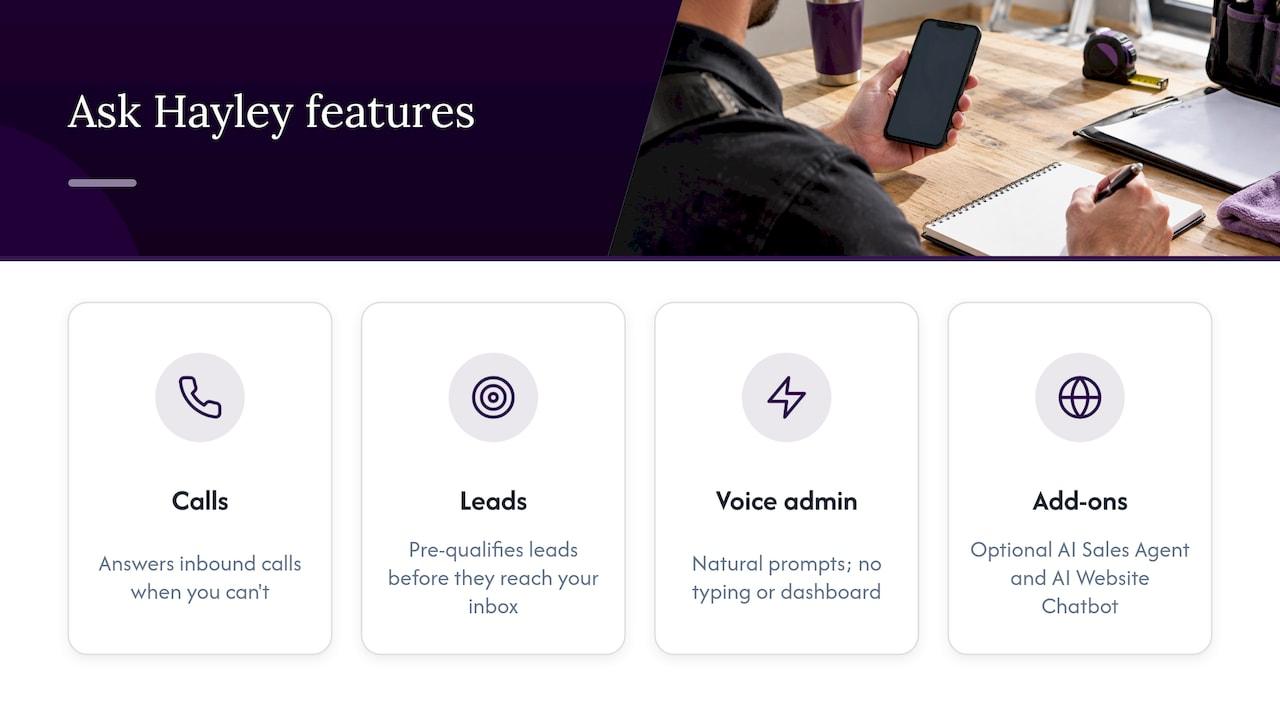
Ask Hayley is a voice-first business management platform built for Australian tradies and small service businesses. Hayley answers inbound calls when you can’t, pre-qualifies leads before they reach your inbox, and handles day-to-day admin through natural voice prompts, so there’s no typing and no dashboard to learn. The platform has two core plans, Assistant and Office Manager, with optional add-ons including an AI Sales Agent and an AI Website Chatbot for wider coverage across calls, leads and customer enquiries.
It also covers quoting, invoicing, tasks, calendar, compliance tracking and reporting, with integrations to Xero. If you’re presenting your business to bigger clients, we also do website design, tender preparation and safety and compliance documentation.

To see how Hayley could handle the calls you can’t, start at askhayley.com.au.
A simple 4-week plan to start
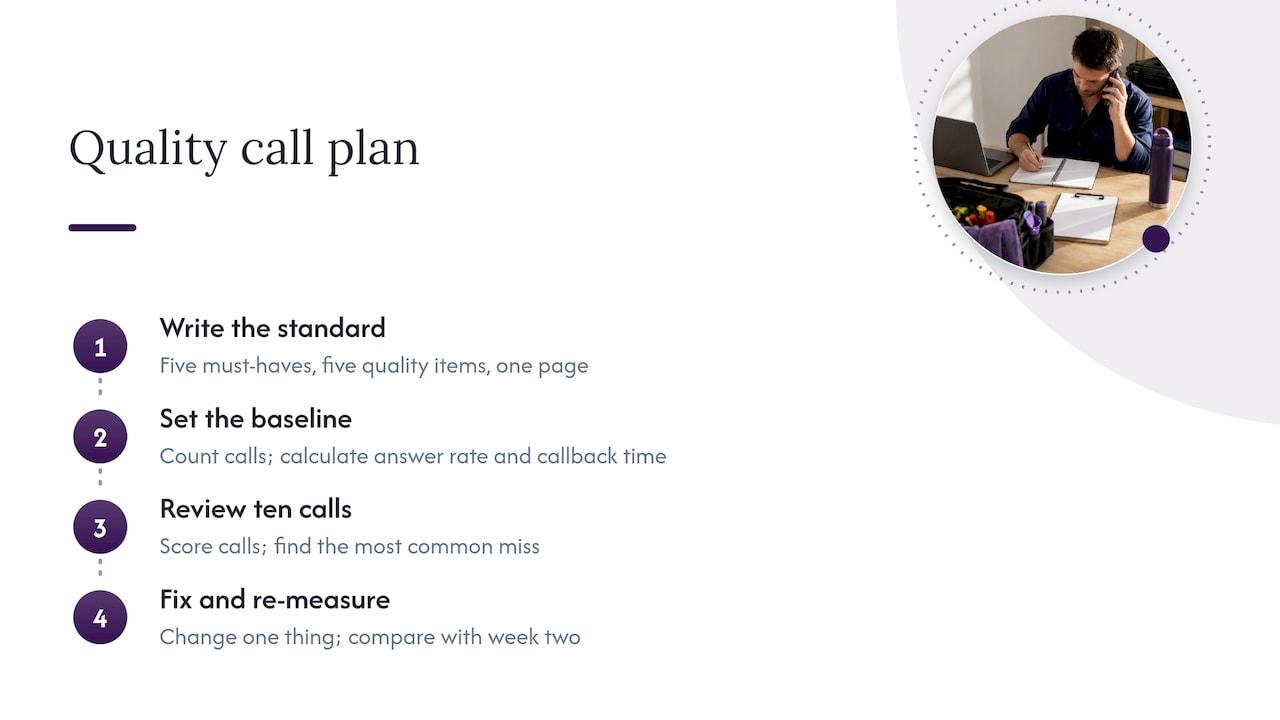
Week 1: Write the standard. Five must-haves, five quality items, one page. Add your recording notice if you record.
Week 2: Baseline. Count your inbound calls, answered calls and missed calls. Work out your answer rate and your average callback time.
Week 3: Review ten calls. Score them. Find the single most common miss.
Week 4: Fix and re-measure. Change one thing, such as a new voicemail, a faster callback rule or a better set of opening questions. Compare your numbers with week 2.
Then repeat. Small, steady changes add up, and after a couple of months you’ll have a clear picture of which calls turn into jobs and which don’t.
FAQ
What does quality assurance include for customer calls?
It includes a defined standard for what a good call looks like, a regular review of a sample of calls against it, feedback to whoever answers, and a fix for any pattern you find. For a trade business, that standard should cover capturing the caller’s details, speed of response and a clear next step.
Do I need to tell customers I’m recording the call?
Yes, as a safe standard everywhere in Australia. Tell the caller at the start that the call is recorded, so they can carry on or ask not to be recorded. Laws differ by state and territory, so if you work across borders or are unsure, check with a solicitor.
How many calls should I review?
Ten a week is plenty for a small business. Include answered calls, calls handled by staff and calls that didn’t turn into a job. If you take fewer than ten calls a week, review them all.
What’s the difference between QA and QC on calls?
Quality assurance focuses on preventing problems by improving the process, such as scripts, answering rules and callback times. Quality control checks finished calls to find errors that have already happened. A small business benefits from both, but fixing the process gives the bigger payoff.
Sources
- ACXPA: Call Centre Quality Assurance, the Complete Guide
- Australia Recording Laws: State-by-State Rules
- Is It Illegal to Record Someone Without Consent in Australia?
- OAIC: Chapter 2, Collecting health information
- OAIC: Passing of bill a significant step for Australia’s privacy law
- Sprintlaw: Workplace Communication Legislation


