


An on-call roster names who is on standby after hours, for how long, and what happens when the phone rings. The best way to run one in a trade business is to keep it simple: a fixed rotation, a written response standard, a clear pay rule from your award, and a way for every call to be answered even when the rostered person is under a house. We built Ask Hayley around that last part, because Hayley answers inbound calls when you can’t.
This guide is for electricians, plumbers, HVAC and air con techs, roofers, glaziers, garage door repairers and other trades where a burst pipe, a dead switchboard or a stuck door at 9 pm is a real job and a real customer.
TL;DR
- An on-call roster is different from a work roster: the person is free to use their time but must stay reachable and able to respond within an agreed timeframe.
- Rotate duty on a fixed cycle, write down the response standard, and name a backup for every shift.
- Pay depends on your award or agreement. Typically that means an on-call allowance plus overtime rates for actual callouts, with minimum engagement and rest rules.
- The right to disconnect now applies to small businesses too, so a written roster protects you and your crew.
- Missed calls are the weak point of any roster. Hayley answers calls you can’t and pre-qualifies leads before they reach your inbox.
Table of Contents
- What on-call rostering actually means
- Step 1: Decide what you are actually covering
- Step 2: Set a response standard you can actually meet
- Step 3: Build the rotation
- Step 4: Get pay and rest right
- Step 5: Respect the right to disconnect
- Step 6: Close the gaps in coverage
- Step 7: Record every callout
- Where Ask Hayley fits
- Common mistakes to avoid
- FAQ
- Sources
What on-call rostering actually means
A normal roster says when someone is working. An on-call roster says when someone is available. During a standby period the worker is not necessarily doing anything. They can be at home or at the footy, but they have to be reachable and ready to come in if called.
The AMA (NSW) describes this in hospital terms: a doctor can be rostered on call for a 24-hour period, contacted about patients while away from the hospital, and called back in. The same logic applies to a sparky on emergency power faults or a plumber on blocked drains over the weekend.
There are two separate things to keep apart:
- The standby period. The person is available, but not working.
- The callout. The person is asked to do work, and that is paid work.
Sprintlaw Australia draws the same line between the standby period and the call-back work, and it matters because pay and entitlements follow it.
The informal on-call trap
Many small crews run an unwritten system. The boss’s phone is always on, or “whoever’s closest” takes the call. That is still on call in practice. A workforce provider notes that workers expected to stay reachable and respond at short notice are functionally on call, even where nobody formally rostered them. If you expect it, roster it, write it down and pay for it properly.
Step 1: Decide what you are actually covering
Before you put names in a calendar, define the service. Ask:
- Which hours? Weeknights only, weekends, public holidays, or all of them?
- Which jobs? True emergencies (no power, flooding, a roof open to the weather, a broken front door lock) or any enquiry?
- Which area? The distance a tech can realistically travel inside your response time.
- Who is eligible? Only people with the licence and training for emergency work.
The NSW Industrial Relations Commission’s skilled trades award for public health employees is a useful model of what a workable arrangement considers. It says on-call arrangements are determined in consultation with affected employees, having regard to availability, training, local geography and travel distances. That is a public sector award, so it is not your rulebook, but the thinking transfers. A roster that ignores skills and travel time will fail the first time a call comes in from the wrong side of town.
Step 2: Set a response standard you can actually meet
Two numbers turn a roster into a service: how fast you call back, and how fast you arrive. One contractor trade publication suggests an internal standard such as a callback within 30 minutes and arrival within two hours in the core service area. It gives the customer an answer and gives you a measure to review.
Your numbers may differ. A one-person air con business might promise a callback in an hour. A plumbing crew with three vans might promise 30 minutes. What matters:
- The standard is written, and the on-call person knows it.
- You tell the customer the same thing (on your website, voicemail and quotes).
- You review how often you hit it. Our guide on first call answer rate shows why the first answer matters so much, and field service KPIs covers other numbers worth tracking.
Step 3: Build the rotation
Fairness is what keeps good people. A rotation that always lands on the newest apprentice, or the one who never says no, will cost you staff.
Pick a cycle and stick to it
| Crew size | A workable pattern |
|---|---|
| 2 people | Alternate weeks, with the other as backup |
| 3 to 4 people | One person per week, rotating in order |
| 5 or more | Split weeknights and weekends so nobody carries both every time |
Weekly blocks are easy to remember. Weekend-only blocks suit crews where the weekdays already run late. Whatever you pick, publish it well ahead, so people can plan family time.
Handle swaps without chaos
People will need to swap. Set the rule once:
- Swaps are agreed between the two workers and confirmed to you in writing (a text is fine).
- The roster is updated before the shift starts, not after.
- Nobody is left on two weeks in a row because a swap went wrong.
Always name a backup
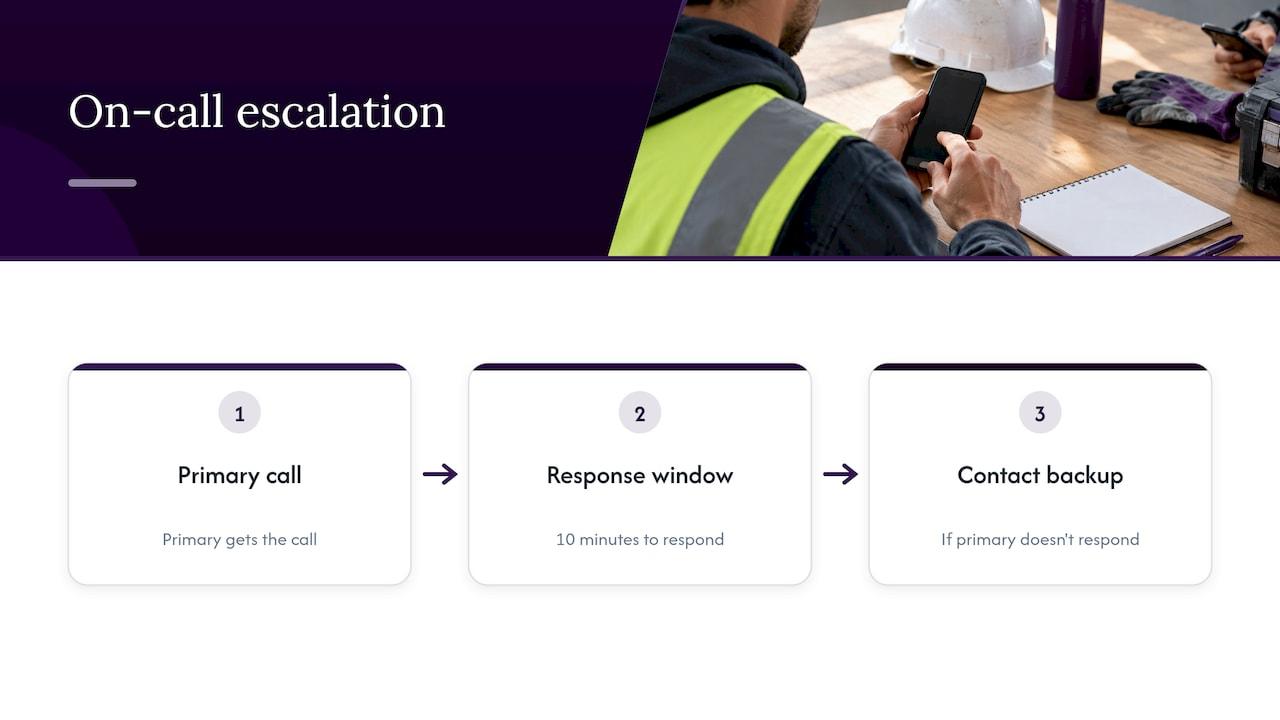
Every shift needs a second name. The primary person might be mid-job on an earlier callout, sick, or out of range. The backup is who gets the call if the primary doesn’t respond in your set time, for example 10 minutes.
Step 4: Get pay and rest right
This is where small businesses get caught. On-call pay is set by your modern award, enterprise agreement or employment contract, not by the roster. Sprintlaw explains that being available is different from actually working, and that entitlements can include an availability allowance, a minimum call-out payment, or payment for the hours worked.
For trades, the Fair Work Commission’s award pages are the place to check. The Plumbing and Fire Sprinklers Award 2020 is one example. Awards of this kind typically provide:
- A daily or weekly on-call allowance for being on standby.
- Overtime rates for work actually done on a callout.
- A minimum engagement period for callouts (commonly in the range of two to four hours).
- A rest break between a late recall and the start of the next shift.
The exact amounts, which change when the Fair Work Commission adjusts award rates, are listed on the award itself. Electricians sit under a different instrument, the Electrical, Electronic and Communications Contracting Award 2020, and other trades have their own awards, so find the one that covers your people. Check the current figures on the Fair Work site, or ask your accountant or payroll provider, rather than relying on last year’s number.
A worked example
Say your award provides a weekly on-call allowance and a three-hour minimum for callouts. Your plumber is on call Monday to Sunday. On Wednesday at 11 pm, a customer calls with a burst hot water service. Your plumber attends for 90 minutes.
- The week’s allowance is paid for being on call.
- The callout is paid at the overtime rate, and the minimum engagement rule may mean three hours’ pay instead of 90 minutes.
- If the job finishes at 1 am, the rest-break rule may affect when the plumber starts on Thursday.
That is why you write it down. Your roster should state the allowance, the callout pay rule and the rest rule in plain words, so nobody is surprised on payday. Use your own award’s real figures.
Step 5: Respect the right to disconnect
If you expect staff to answer after-hours calls, the right to disconnect is part of the picture. Per the Fair Work Ombudsman, it has applied to non-small business employees since 26 August 2024 and to small business employees since 26 August 2025. Employees may refuse out-of-hours contact unless refusing is unreasonable.
What does that mean for a tradie boss? A documented on-call roster, with agreed pay, is the clearest way to show that after-hours contact is expected, planned and paid. People who are not on the roster should not be getting 8 pm calls. Keep the roster as the single list of who is reachable and when.
Step 6: Close the gaps in coverage
A roster only covers the person. It does not cover the call that rings out while your on-call tech is on a roof, in a switchboard, or driving. The three common gaps:
- The call comes in while the on-call person is busy. They can’t pick up and the customer rings the next business.
- The enquiry isn’t an emergency. A quote request at 7 pm interrupts someone’s dinner for no reason.
- The details are lost. A name and a suburb scribbled on a napkin never makes it to the job list.
The fixes:
- Put a clear message on your voicemail. See our voicemail scripts for Australian tradies for wording that tells callers what happens next.
- Separate emergencies from routine enquiries at the point of the call, so only the real emergencies wake someone up.
- Capture every caller’s details straight into your job list. Our guide to hands-free job scheduling shows how to keep the schedule up to date from the ute.
- Send confirmations so customers know someone is on the way. SMS appointment reminders cut the back and forth.
A simple on-call schedule template
Share this with your team each month:
- Week commencing: date
- Primary on call: name and mobile
- Backup: name and mobile
- Hours covered: for example 5 pm to 7 am weekdays, all weekend
- Service area: suburbs or postcodes
- Response standard: callback in X minutes, arrival in X hours
- Escalation: if no answer in 10 minutes, call the backup, then the owner
- Pay: allowance and callout rules per the award
- After the job: log the job, the time on site and any materials by the next morning
Put it where everyone can find it: a shared calendar, a pinned message in your crew chat, and a printed copy in the workshop. A roster nobody can find is not a roster.
Step 7: Record every callout
After-hours work is easy to forget and expensive to forget. For every callout, record:
- Who called, when, and what the problem was
- When the tech called back and when they arrived
- Hours worked, for payroll
- What was done, and whether a follow-up job is needed
This gives you proof for payroll, a record if a customer disputes the job, and the data to see whether your response standard is realistic. Our piece on work order tracking covers how to keep that trail tidy.
Where Ask Hayley fits
Hayley is a voice-first business management platform for Australian tradies. It answers inbound calls when you can’t and pre-qualifies leads before they land in your inbox. You manage the day-to-day admin by talking, not typing, which suits a tradie with gloves on and a tool in one hand.
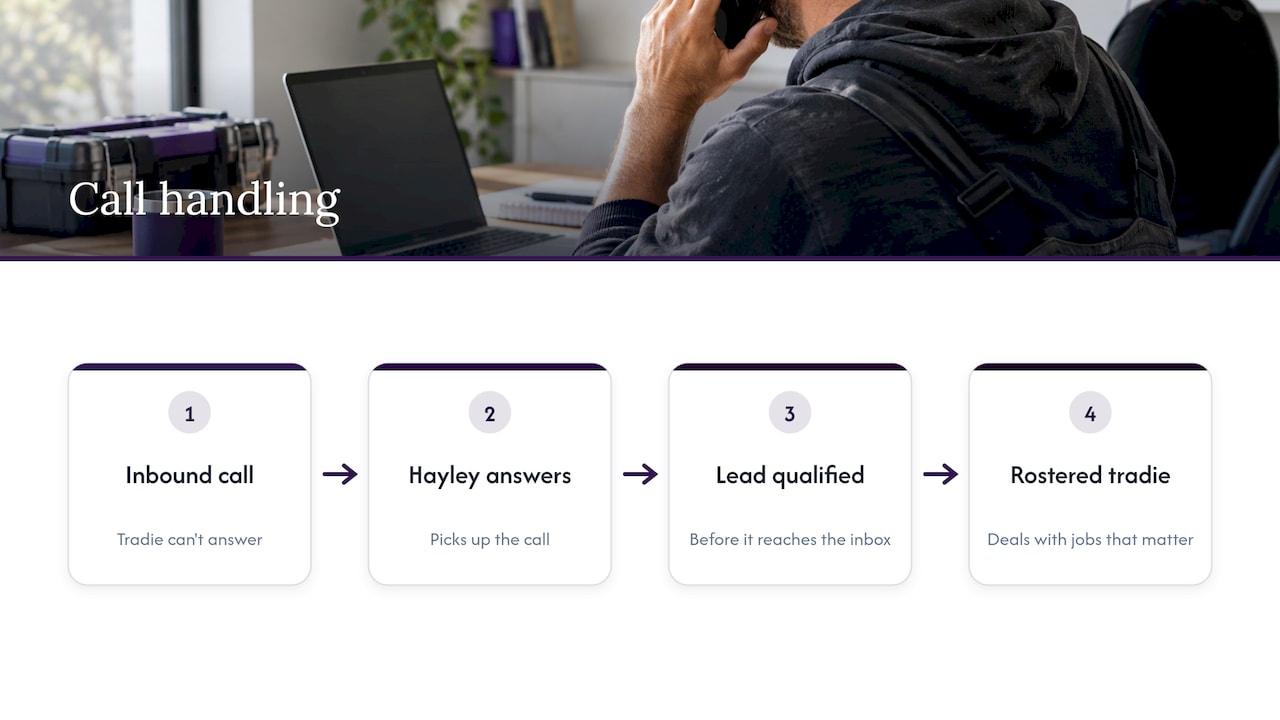
For an on-call roster, that means the rostered person is not the only thing standing between a customer and a missed job. Calls are picked up and the lead is qualified, so the person on standby deals with the jobs that matter.
Hayley comes in two plans, Assistant and Office Manager, with optional add-ons including an AI Sales Agent and an AI Website Chatbot. The platform also covers quotes, invoicing, task management and calendar, and integrates with Xero.

If you also want your business to look the part online or to win bigger work, we also build One Page Websites, and prepare tenders and safety and compliance documentation. Have a look at what we offer.
Our view on on-call rostering
We talk to tradies who are good at the work and tired of the phone. The on-call roster is meant to give them a night off, but too often it just formalises the fact that someone is always on the hook.
We think the roster should decide who goes out. It should not decide who has to be tied to a handset. That is why we built Hayley to answer inbound calls when you can’t and to pre-qualify leads before they reach your inbox.
The rostered person keeps their evening, and the customer still gets a response. And because you run the business by voice, the paperwork after a callout does not wait until Monday at a desk.
Hayley
Common mistakes to avoid
- Rostering by habit. “It’s always been Dave” is not a rotation.
- No backup. One missed call and the whole system fails.
- Vague promises. If customers hear “we’ll get to you soon”, you have no standard to meet.
- Ignoring the award. Allowances and minimum callouts are set by your award or agreement, so look them up.
- Roster in one head. Share the schedule with the whole team and keep it updated.
- Treating every call as an emergency. Triage at the point of the call, or your on-call person will burn out.
FAQ
What is the difference between an on-call roster and a normal roster?
A normal roster sets when people work. An on-call roster sets when people must be reachable and ready to come in if called. The standby is separate from any callout, which is the work itself and is paid accordingly under your award or agreement.
Do I have to pay staff to be on call?
It depends on your award, enterprise agreement or contract. Many trade awards provide an on-call allowance for standby plus overtime for work done on a callout, so check the award that covers your people on the Fair Work site, or ask your payroll provider or accountant.
How long should an on-call shift be?
Weekly blocks are the most common in small trade crews because they are simple to remember and to plan around. Larger crews often split weeknights and weekends. What matters is that the cycle is fair, written down and published well ahead.
Does the right to disconnect apply to my small business?
Yes. It has applied to small business employees since 26 August 2025. Employees can refuse out-of-hours contact unless refusing is unreasonable, so a documented, paid on-call roster is the clearest way to set expectations. See the Fair Work small business news for the details.
What should I do about calls the on-call person cannot answer?
Set a backup and an escalation time, and make sure every caller gets an answer. Hayley answers inbound calls when you can’t and pre-qualifies leads, so a busy rostered tech does not mean a lost job.
Sources
- Rostering, AMA (NSW)
- Paying Employees On-Call, Sprintlaw Australia
- After-Hours Contact and Rostering, Programmed
- Public Health Service Employees Skilled Trades Award 2023, NSW IRC
- Build an Emergency Call Dispatch Playbook, Contractor
- Plumbing and Fire Sprinklers Award 2020 [MA000036], Fair Work Commission
- Latest news for small business, Fair Work Ombudsman


