


Variation order management is the process of recording, pricing and approving contract changes so you keep your time and payment entitlements intact. The single most important action is simple: the moment you know a change has happened, write down the trigger date and send a notice. Standards like AS 4902 and security of payment laws exist to protect that entitlement, but only if you move fast.
TL;DR:
- Notifying changes immediately with written documentation and recording trigger dates is crucial to preserve entitlement under contract laws and legislation.
- Variations under AS 4902 include scope increases, material changes, level adjustments, demolitions, or additions, but only after a formal written direction.
- Prompt, accurate recording of site conditions and verbal instructions in writing within 24 hours prevents claim rejections and protects delays or cost impacts.
- Proper variation valuation requires separating direct, indirect, and consequential costs and incorporating both sell and cost impacts into the same calculation.
- Using voice-first tools for on-site capture and real-time register updates enhances claim accuracy, speeds up processing, and reduces documentation delays.
Table of Contents
- What counts as a variation under AS 4902 and AS 4000
- Step-by-step variation order workflow from site to claim
- Trigger dates, time bars and EOT guidance: a practical checklist
- Valuing variations and protecting your margin
- Variation register and templates for on-site capture
- Common pitfalls that reject or erode variation claims
- How voice-first capture keeps variation admin moving on site
- Practical priorities for tradie teams
- A practical way to handle variation admin without extra apps
- FAQ
- Sources
What counts as a variation under AS 4902 and AS 4000
A variation is any change the superintendent directs to the scope of works under contracts like AS 4902 or AS 4000. It is not every change in circumstances on site. Under AS 4902, a variation typically includes:
- Increasing, decreasing or omitting part of the works
- Changing the character or quality of materials or work
- Altering levels, lines, positions or dimensions
- Demolishing or removing work that would otherwise be left in place
- Adding work that was not in the original scope
There is a real difference between a proposed variation, where the superintendent asks for an estimate before deciding, and a direction to perform, where you are told to carry out the work. You should not start work on a proposed variation until you have a written direction, because acting too early can weaken your claim. Security of payment legislation in each Australian state sits alongside these contract mechanisms, giving you a statutory right to progress payments regardless of how a variation dispute is tracking.
Step-by-step variation order workflow from site to claim
Once a change is identified, the clock starts. A consistent process protects your entitlement and keeps cash flow moving.
- Record the trigger date immediately. Note the date you first became aware of the change, who raised it, and any supporting detail such as photos or a site diary entry.
- Issue an initial variation notice with your best estimate of time, cost and program impact “as soon as practicable,” as NSW procurement guidance recommends.
- Prepare a detailed quotation if asked. Note separately if you intend to claim the cost of preparing that estimate, since some contract wording allows this.
- Get written direction before starting work wherever possible. If the instruction is urgent and verbal, document who gave it, when, and ask for written confirmation straight away.
- Update your variation register with the approved scope, value and status, then fold it into your next progress claim so payment follows the work.
Pro Tip: Treat every variation as three separate claims in disguise: the variation itself, any extension of time, and the cost impact. Each one needs its own paperwork and its own timing.
Trigger dates, time bars and EOT guidance: a practical checklist
The “trigger date”, sometimes called the date of knowledge, is the day you first became aware of the event causing delay or extra cost. Legal commentary from Bartier Perry points out that missing this date, or failing to keep contemporaneous records, is one of the most common reasons variation claims get knocked back.
Clause 34.3 under AS 4902 commonly requires an extension of time claim within 28 calendar days of becoming aware of the delay. If your crew hits unexpected rock on a Tuesday, the 28-day clock usually starts that Tuesday, not when you eventually submit a formal claim weeks later.
A short checklist helps crews act in the moment:
- Note the date, time and who identified the issue
- Photograph the condition or defect before it changes
- Copy the superintendent and your site manager the same day
- Follow up any verbal instruction with a written confirmation request within 24 hours
- File the note against the relevant variation ID, not in a loose folder
A single missed notice window can be the difference between a paid variation and an unpaid one, which is why AS 4902 practice treats the estimate and the notice as linked obligations.
Valuing variations and protecting your margin
Pricing a variation properly means capturing more than the obvious labour and materials. A complete quotation should separate:
- Direct costs: labour, plant, materials and subcontractor charges tied straight to the change
- Indirect costs: supervision time, additional site establishment, delay-related overheads
- Consequential costs: knock-on effects to other trades or sequencing
Most contracts set a pricing ladder: first any prior agreement on rates, then contract rates where they apply, and only then “reasonable rates” where nothing else covers the work. Keep the order in mind before you quote, since jumping straight to reasonable rates when contract rates apply can undercut your own claim.
Pro Tip: Record the sell impact and the cost impact on the same line of your register, not in separate spreadsheets. Seeing the margin before you submit the variation stops scope creep eating your profit quietly.
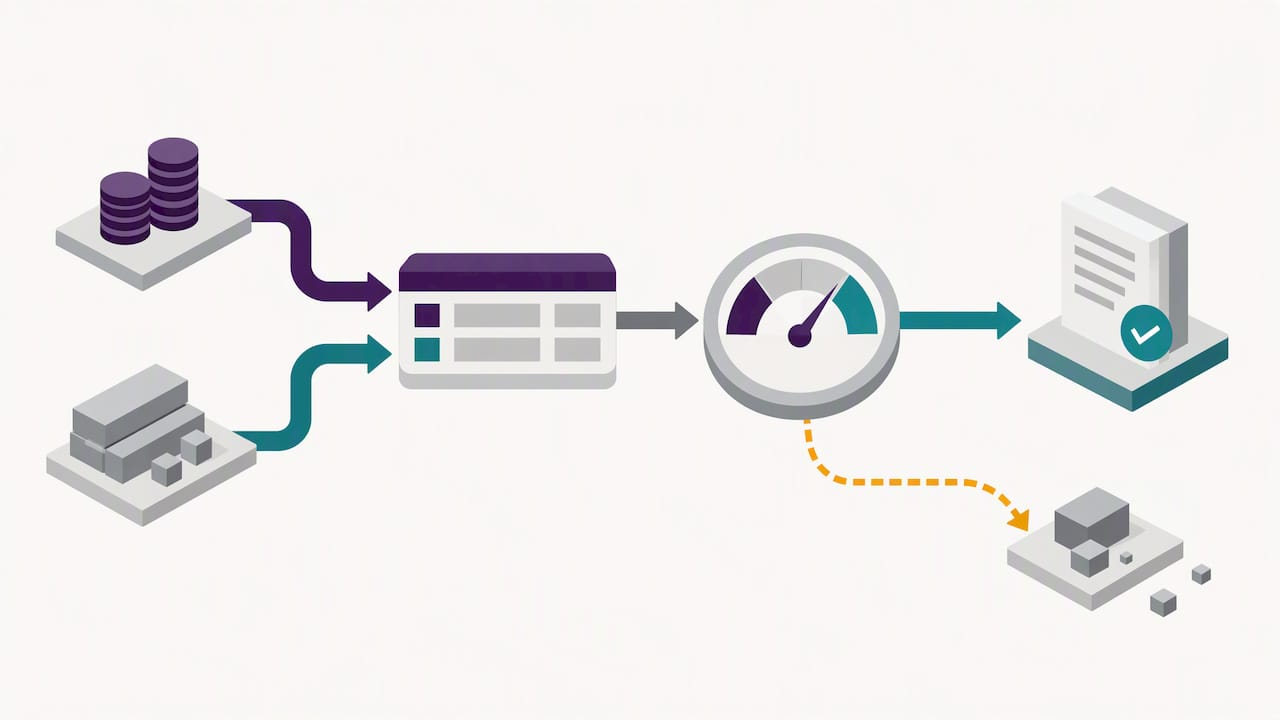
Folding approved variations into your next progress claim, rather than holding them for a later catch-up claim, keeps cash moving and reduces disputes over what was actually agreed.
Variation register and templates for on-site capture
A good register is only useful if the fields are consistent. At minimum, track:
- Variation ID and description
- Trigger date and notice date
- Sell impact, cost impact and resulting margin
- Approval status and who approved it
An initial notice template should cover the event, the estimated time and cost impact, and a reference to the clause it falls under. A detailed quotation adds a full cost breakdown and any claim for the time spent preparing it.
For tools, Australian sites typically choose between dedicated field capture apps, commercial variation registers built into project management platforms, offline-capable tools for remote sites, and the humble spreadsheet as a fallback. Whichever you choose, check it integrates with your accounting software such as Xero, supports photo or document evidence, and still works without reception on site.
Common pitfalls that reject or erode variation claims
Most rejected claims come down to a handful of repeatable mistakes.
- Reconstructing evidence after the fact instead of recording it on the day the change was identified.
- Not confirming oral instructions in writing, leaving a dispute down to memory against memory.
- Mixing sell-side and buy-side figures so nobody can see the real margin until it is too late to act.
- Underclaiming indirect and consequential costs, or forgetting that preparation of an estimate can itself be claimable.
Each of these is avoidable with a habit, not a system overhaul: write it down, confirm it in writing, and keep the numbers separate until you are ready to see the total.
How voice-first capture keeps variation admin moving on site
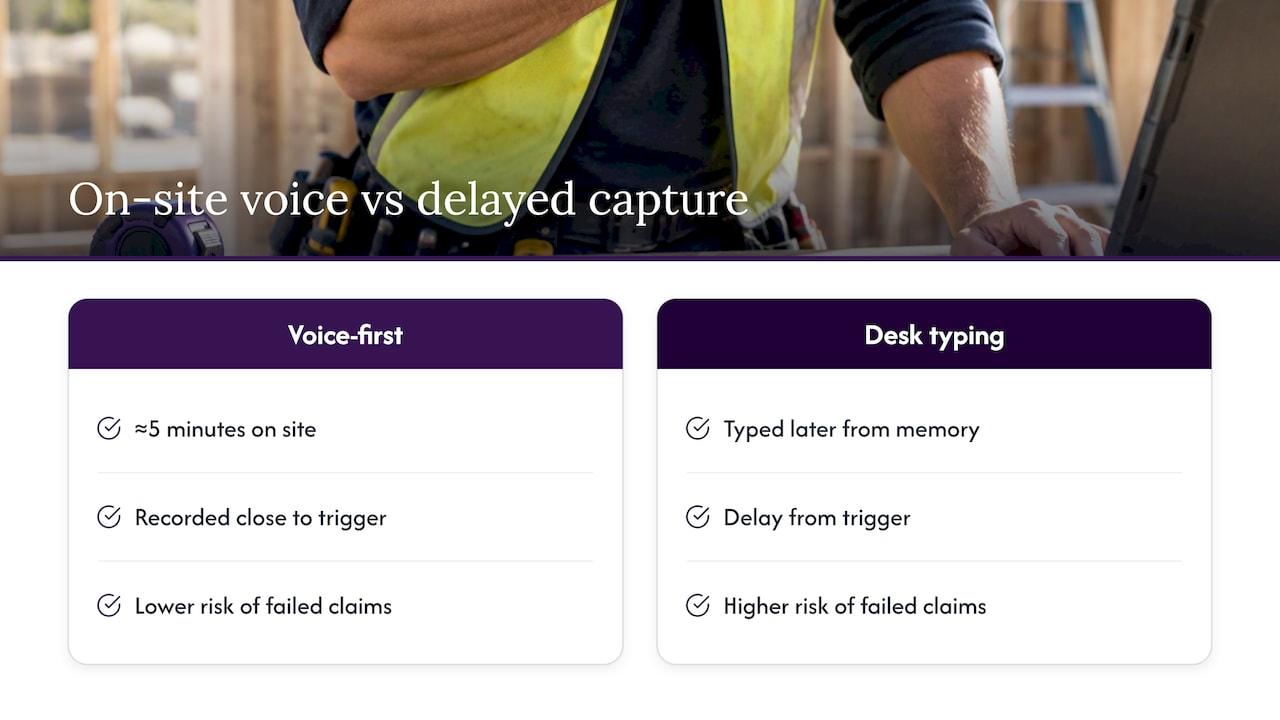
Ask Hayley is built around the reality that most variation admin gets delayed because someone is on a roof, not at a desk. Talking through a variation note or work order takes less time than typing it later from memory. Teams using voice capture to finish purchase order admin in five minutes on site shorten the gap between the trigger date and the recorded notice, which is exactly where most claims fall over.
Practical priorities for tradie teams
Variation order management comes down to one habit: record the trigger date and notify in writing the day you know about a change. Three things make that easier for a crew: a quick daily site note, voice capture instead of typing at night, and updating the register before the detail fades.
— Hayley
A practical way to handle variation admin without extra apps
We know most crews already have enough screens to check. Ask Hayley lets you log a variation, update a work order, or knock over purchase order admin by talking, not typing, which matters when your hands are full and the trigger date is ticking.

A typical workflow looks like this: capture the change on site by voice, have it land straight in your variation register, then carry the approved value into your next progress claim.
- Voice capture reduces the time between spotting a change and recording it
- Work order tracking keeps variation status visible to the whole team
- Progress claim integration helps approved variations get processed sooner
If you want to see how this fits your own jobs, visit Ask Hayley and book a time to walk through it.
FAQ
What is a variation agreement?
A variation agreement is the written record, usually a direction or signed quotation, confirming that both parties agree to a change in scope, time or cost under the contract. It turns a proposed change into an enforceable part of the works once signed.
What are the four types of construction contracts?
Australian construction projects commonly use lump sum, cost-plus, construction management and design-and-construct contract models, each allocating risk and payment differently. Standard forms such as AS 4902 and AS 4000 can sit under several of these models depending on how the project is structured.
What is the difference between a change order and a variation order in construction?
In Australian practice, “variation order” is the standard term used under contracts like AS 4902, while “change order” is more common in North American contracting language. They describe the same concept: a directed change to scope, time or cost that modifies the original contract.
How long do I have to claim an extension of time after a variation?
Under clauses like 34.3 in AS 4902, you typically need to lodge an extension of time claim within 28 calendar days of becoming aware of the delay. Missing this window can bar the claim entirely, so recording the trigger date on the day it happens matters more than the quality of the paperwork that follows.
Sources
For contract wording and time bars, refer to NSW procurement guidance, the Department of Finance policy note on senior oversight, and legal commentary from Bartier Perry and Turtons on AS 4902 claims. Electrical crews checking clause references may also find the AS3000 & SIRNSW Clause Finder useful.
- Construction procurement guide: managing variations | info.buy.nsw
- How to claim a variation under AS 4902 | Turtons
- Navigating an AS 4902-2000 contract: legal traps and safeguards | Bartier Perry


