


Voicemail records a message and leaves the work with you. Call answering puts a live person or an AI voice on the line, so the caller gets a response straight away and you get a qualified job note. For most tradies, voicemail is fine as a safety net but weak as a front door. Answering the call, then following it up, is what wins the job.
This guide explains the difference, what each costs, what happens to the caller, and how to choose. It is written for tradies who spend the day on roofs, under sinks and in ceiling cavities, not at a desk.
TL;DR
- Voicemail is usually free with your phone plan, but it relies on the caller leaving a message and you ringing back quickly. A customer shopping around often won’t wait.
- Call answering (a receptionist, an answering service or an AI voice assistant) picks up in real time, asks the right questions and passes you the details.
- Cost is the real trade-off. Voicemail costs little. Answering is a monthly subscription, so judge it against what one booked job is worth to you.
- Many tradies do best with both: answering for busy hours, a clear voicemail as the backup.
- Test one change at a time and track answered calls, booked jobs and callback time before you commit.
Table of Contents
- What is the difference between voicemail and call answering?
- What happens to the caller in each case?
- Side-by-side comparison
- What does each option cost?
- Where voicemail falls short for trades
- Where call answering falls short
- Does answering actually help win more jobs?
- How to choose: voicemail, call answering or both
- What to do after the call
- Our view: why we built Hayley around the phone
- Where Ask Hayley fits
- FAQ
- Sources
What is the difference between voicemail and call answering?
Voicemail is a recording system. The phone rings out, a greeting plays, and the caller can leave a message. Nothing happens until you listen to it. Everything after that, the callback, the questions about the job, the quote, is on you.
Call answering is a conversation. Someone or something picks up when you can’t, greets the caller by your business name and collects what you need. That might be:
- A live answering service or virtual receptionist. A real person takes the call, usually for a number of calls per month.
- An in-house receptionist or office manager. A person on your payroll or a family member doing the books on weekends.
- An AI voice assistant. Software that answers, asks questions and logs the lead.
The key difference is not technology. It is whether the caller’s need is acknowledged while they are still on the line.
What happens to the caller in each case?
Put yourself in the customer’s boots. Their hot water system has died, or a tree has come down on the fence. They search, tap the first few numbers and ring.
With voicemail
They hear your greeting, then a beep. Some leave a message. Plenty hang up and ring the next business on the list. The ones who do leave a message have no idea when you’ll call back, and they still don’t know whether you service their suburb or do the type of job they need.
Voicemail also gives you poor information. “Hi, it’s Dave, call me back” tells you nothing about urgency, location or scope. You end up playing phone tag at 6pm when you’re tired.
With call answering
The caller reaches a voice straight away. A good setup asks a short list of questions: name, suburb, what the problem is, how urgent it is and the best number. It can tell an emergency from a quote request. Then it tells the customer what happens next, such as “Someone will call you back this afternoon”.
That last step matters. A caller who knows the next move is far more likely to wait for you instead of ringing around.
Side-by-side comparison
| Factor | Voicemail | Call answering |
|---|---|---|
| Caller experience | Greeting, beep, no reply | Immediate response and a clear next step |
| Information captured | Whatever the caller chooses to say | Structured details: name, suburb, job type, urgency |
| Speed of your response | Depends on you checking and ringing back | You can act on a ready summary |
| After-hours coverage | Records only | Answers and triages (depending on the service) |
| Typical cost | Usually bundled with your phone plan | Monthly subscription, varies by provider and call volume |
| Setup effort | Record a greeting | Brief the service or configure the assistant |
| Risk | Callers hang up or go elsewhere | Mistakes in details, or poor handling of tricky calls |
What does each option cost?
Voicemail is normally included. The Australian Communications and Media Authority (ACMA) notes that all phones have voicemail unless you ask your telco to remove it. It also says a telco may charge a connection fee for calls answered by voicemail, depending on your plan. Check your plan if you forward calls to message bank a lot.
Call answering is a different kind of cost. Live services usually charge a monthly fee that covers a set number of calls, with extra charges beyond that, and some add a setup fee. Receptionist services that transfer calls typically cost more than messages-only plans. AI-based options are generally priced as a subscription too. Because plans differ a lot, get written quotes and check:
- How many calls are included, and what each extra call costs.
- Whether the price includes GST.
- Setup fees and contract length.
- Whether after-hours calls cost more.
- What you get after each call: a text, an email or an entry in your job list.
The sums that matter are simple. If your average job is worth a few hundred dollars and an answering plan helps you win one extra job a month, the fee may pay for itself. If you rarely miss calls, voicemail may be all you need. Count your own missed calls for two weeks before deciding. Don’t assume every missed call is a lost job: some callers are salespeople, wrong numbers or existing customers who will ring back.
Where voicemail falls short for trades
Trade work is the worst case for voicemail. You are on a ladder, in a roof space, on the tools or driving between jobs. Miss a call at 10am and you may not check messages until the afternoon. By then, the customer has often booked someone else.
A few specific problems:
- Full mailboxes. If your inbox is full, the caller hears an error and hangs up.
- Poor reception. Rural, coastal and basement jobs can send calls to voicemail you never knew about.
- No qualification. You can’t tell a $20,000 reno from a tap washer without ringing back.
- Quiet leaks. Messages sit unplayed because there’s no prompt or list.
If you stay with voicemail, make the greeting do some work. It should name your business, say when you check messages, ask for suburb and job type, and offer a next step. We’ve put together voicemail scripts for Australian tradies you can adapt.
Where call answering falls short
Call answering isn’t magic either.
- Quality varies. A live service that doesn’t know your trade can mishear a job or book the wrong thing. Give it a clear script, your service area and your emergency rules.
- Reliability. Business phone faults happen. ACMA’s research on Australian businesses found that 40% had experienced an issue or fault with a business-phone service (2019 data), so a good setup needs a backup path when a line or service drops.
- Cost creep. Per-call pricing can climb in a busy month.
- Customer comfort. Some older customers prefer to speak to the tradie directly. A friendly handoff, such as “Dave will call you back within the hour”, handles that.
- Handling privacy. If a service records calls, tell callers. Check your state’s rules and your provider’s terms before you switch on recording.
Does answering actually help win more jobs?
The honest answer: it helps when the problem is that you miss calls and respond late. It doesn’t help if your pricing or availability is the issue.
There is growing evidence that Australian small businesses are moving this way. NAB reported in July 2026 that 40% of Australian SMEs were actively using AI, and described a Sydney mechanic using missed-call follow-up and an AI voice agent to respond faster, handle questions out of hours and convert leads that would otherwise have slipped away. One example isn’t proof it works for everyone. It does show the approach is no longer experimental.
Don’t rely on generic conversion claims. Measure your own numbers.
A simple two-week test
- For one week, log every missed call: time, type of job if known, whether they left a message and whether you won the job after calling back.
- Change one thing, such as adding an answering option for working hours.
- For the next week, log the same details plus how many calls were answered, how many became quotes and how many turned into booked jobs.
- Compare booked jobs, mistakes (wrong address, wrong job type), how often a call needed escalating, and the cost per booked job.
Change only one thing at a time, otherwise you won’t know what made the difference.
How to choose: voicemail, call answering or both
Use these criteria.
Stick with voicemail if:
- You are a one-person operation with few calls and a loyal repeat customer base.
- You mostly work by referral and callers expect to wait.
- You can return messages within an hour.
Move to call answering if:
- You miss several calls a week while on the tools.
- You do emergency or time-sensitive work (plumbing, electrical, locksmith-style jobs, tree removal after storms).
- You advertise online, where callers contact several businesses at once.
- You want after-hours enquiries captured instead of waiting until morning.
Use both if:
- You want answering for the working day but a good voicemail for overflow, outages and unusual hours.
- Your volume is seasonal, so you only want extra cover in peak periods.
A hybrid also fits how most trades actually run. Calls come in bursts: nothing for an hour, then four at once. An answering layer catches the burst, and voicemail sits underneath as a net. Our guide on call overflow for Australian tradies covers how to set up that backup.
What to do after the call
Answering the call is half the job. The other half is following up quickly. Whichever option you choose, set a rule: every lead gets a response within a set time, for example the same morning for calls received overnight. Our piece on missed call recovery shows how to turn missed calls into booked work, and a steady follow-up cadence stops quotes going cold.
If you’re also thinking about a website chatbot to catch enquiries that don’t come by phone, see how live chat compares with a chatbot.
Our view: why we built Hayley around the phone
We built Ask Hayley because the usual advice for tradies, “just sit down and set up the software”, ignores the day you actually have. You’re on site, hands full, and the phone rings at the worst possible moment.
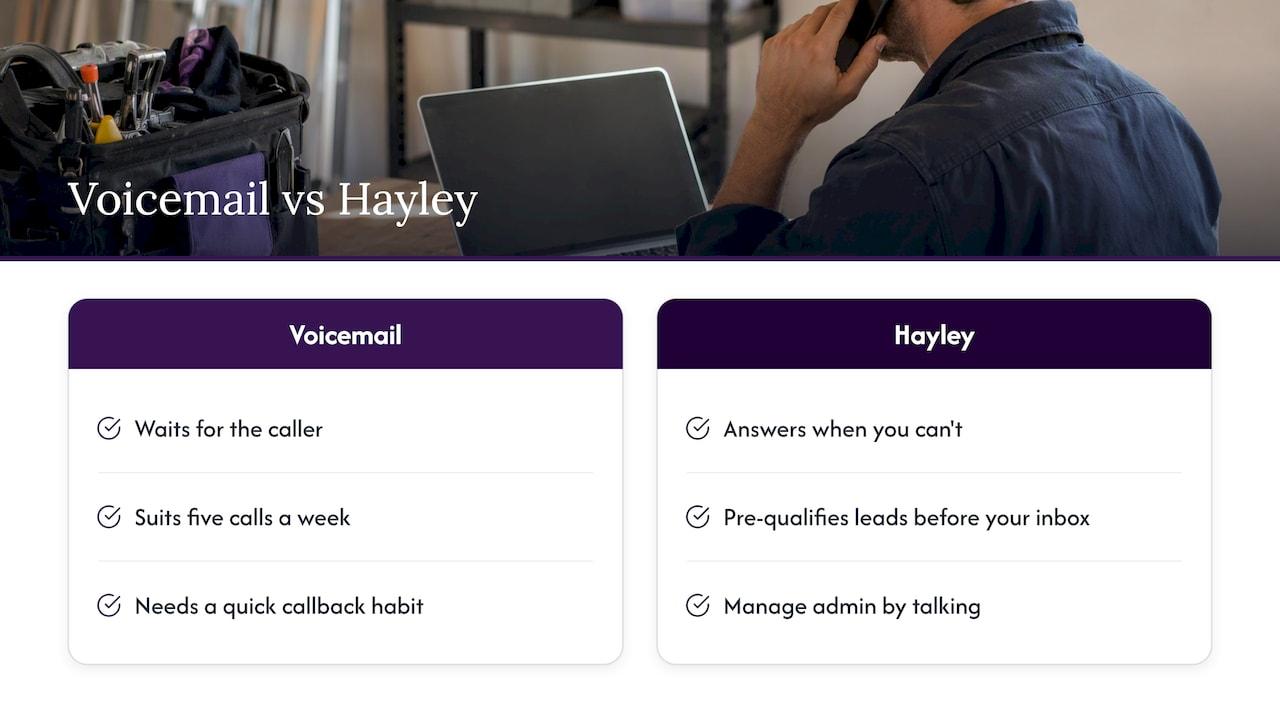
Our view is simple. Voicemail isn’t wrong, it’s just passive. It waits for you. A tradie’s business shouldn’t depend on the customer being patient. So Hayley answers inbound calls when you can’t, asks the questions that matter and pre-qualifies leads before they land in your inbox. Because it’s voice-first, you can also manage the admin by talking: no forms, no dashboards, no extra app to learn.
We don’t think every tradie needs the same thing. If you’re a sole operator with five calls a week, a sharp voicemail greeting and a quick callback habit might be plenty. If calls are where your revenue comes from and you keep missing them, you need something that picks up. What we’d urge you to do, whichever way you go, is measure it. Count the calls. Count the jobs. Then decide.
— Hayley
Where Ask Hayley fits
Hayley is a voice-first business management platform for Australian tradies and small service businesses, with Assistant and Office Manager plans and optional add-ons such as an AI Sales Agent and AI Website Chatbot. It answers calls you can’t, qualifies leads and handles everyday admin through voice prompts. It also works with tools many tradies already use, including Xero and AroFlo.
If you want to see how it would handle your calls, start at the Ask Hayley homepage.
FAQ
Are voicemail and an answering service the same thing?
No. Voicemail is an automated recording that stores a message for you to play later. An answering service puts a person or an AI assistant on the line to speak with the caller, collect details and tell them what happens next.
Does voicemail cost anything in Australia?
Usually it’s included with your phone service. ACMA says telcos may charge a connection fee for calls answered by voicemail, depending on your plan, so check your plan details and ask your telco if you’re unsure.
Will customers hang up on an answering service?
Most callers just want a clear response. A short, friendly greeting in your business name and a stated next step, such as a callback time, usually works better than a beep. Callers who prefer to speak to you directly can be told you’ll ring them back shortly.
Can I use voicemail and call answering together?
Yes, and many tradies do. Let answering handle calls during your working day and busy bursts, and keep a well-written voicemail as the backup for outages or unusual hours.
How do I know if call answering is worth the money?
Log your missed calls for two weeks, then trial one change and compare booked jobs, mistakes and cost against your average job value. If it wins you more work than it costs, keep it. If not, tighten your voicemail and callback routine instead.
Sources
- Call charges from mobile phones, ACMA
- Telco consumer experience, Australian businesses: phone and internet, ACMA
- AI changing how Australian SMEs get work done, NAB


