


A lead to job handoff is the moment an enquiry stops being “someone who rang” and becomes a confirmed job that somebody owns, with the details the person doing the work needs. Get it right and the customer feels looked after from the first call. Get it wrong and you get the classic tradie mess: a quote nobody followed up, a site address in a text thread, and a crew turning up without knowing the access issue.
This guide walks through the handoff stage by stage, what to capture, who should own each step, and how to keep it light enough to run from the ute.
TL;DR
- A handoff happens at every stage: enquiry to qualified lead, lead to quote, quote to accepted job, accepted job to the person on the tools.
- Each stage needs one named owner, one place where the details live and one clear “done” test.
- Capture a minimum set of facts once, at first contact, and carry them forward instead of asking the customer again.
- Record why leads are declined or go quiet, so you can close them cleanly and spot patterns.
- Voice tools like Hayley can answer the call, ask the qualifying questions and write up the notes, so the first handoff doesn’t depend on you being free.
Table of Contents
- What a lead to job handoff means for a trade business
- Stage 1: Capture the enquiry before it goes cold
- Stage 2: Qualify the lead so the right jobs move forward
- Stage 3: Site visit, quote and follow-up
- Stage 4: From “yes” to a confirmed job
- Stage 5: The handoff to the person doing the work
- How to stop details getting lost
- What to do with leads that don’t convert
- A worked example: a gutter and roof repair enquiry
- Where Ask Hayley fits
- Our perspective
- FAQ
- Sources
What a lead to job handoff means for a trade business
Most trade businesses think of “the handoff” as one moment: the boss books the job and tells the crew. In practice there are several smaller handoffs before that, and each one is a chance to lose something.
- First contact to qualification. Whoever answers the phone, website form or message passes the enquiry to whoever decides if it’s a fit.
- Qualification to quote or site visit. The details go to the person who will price the job.
- Quote to follow-up. Someone owns the chase until the customer says yes or no.
- Accepted quote to schedule. The office, or you, locks in a date and materials.
- Schedule to the crew. The person doing the work gets the scope, contacts, risks and promises made.
In a one-person business, all five handoffs happen inside your head, which is fine until you’re on a roof and the phone rings. In a business with an office person, a leading hand or a couple of crews, the handoffs happen between people, and that’s where details drop. Closeout Cue makes a related point about field-to-office handover: software can’t act on information the field never records, so the process needs one agreed handover moment and a consistent minimum set of facts.
That’s the whole idea in this article. Agree on the moment, agree on the facts, agree on the owner.
Stage 1: Capture the enquiry before it goes cold
The first handoff is the one tradies lose most often, because it happens while you’re busy. A missed call is a lead handed to whoever picks up next. If you want to see how quickly this matters, our piece on lead response time covers what happens to enquiries that wait.
A solid first contact does three things:
- Acknowledges the enquiry straight away. Even a short “got it, we’ll call you back by 3 pm” beats silence.
- Collects the basics once. Name, number, address or suburb, what the job is, and how urgent it is.
- Sets a committed next step. A call-back time, a site visit slot or a quote promised by a specific day.
This is where an answering service or voice assistant earns its keep. Hayley answers inbound calls when you can’t, asks the questions you’d ask, and puts the result into your business record, so the first handoff isn’t waiting on you to get off the tools. If you’re still working out where your leads come from in the first place, see our guide to tradie lead generation.
Stage 2: Qualify the lead so the right jobs move forward
Qualifying isn’t about turning away small work. It’s about making the same decision the same way every time. A useful qualification covers:
| What to check | Why it matters | Example question |
|---|---|---|
| Service fit | Do you actually do this work? | “Is it a switchboard upgrade or a new circuit?” |
| Location | Is it inside your service area? | “What suburb is the property in?” |
| Timing | Can you meet their date? | “When do you need this done by?” |
| Scope and budget | Is it realistic for both sides? | “Roughly what size is the area?” |
| Decision maker | Can this person approve the work? | “Are you the owner, or is there an agent or strata involved?” |
| Risks | Anything unsafe or hard to access? | “Is there a steep roof, a locked gate, pets on site?” |
These dimensions line up with the Australian lead qualification guidance in the research behind this article: fit, geography, timing and capacity, job value, authority and safety or feasibility risk. Photos or a short video help a lot for roofing, tiling, fencing and concreting jobs, where the customer’s description and the reality often differ.
The outcome of qualification should always be one of four next actions: a phone estimate, a paid or free site visit, a referral to someone else, or a polite decline. If you can’t name which one, the lead isn’t qualified yet. We’ve written up a short set of questions in our voice triage guide that you can adapt to your trade.
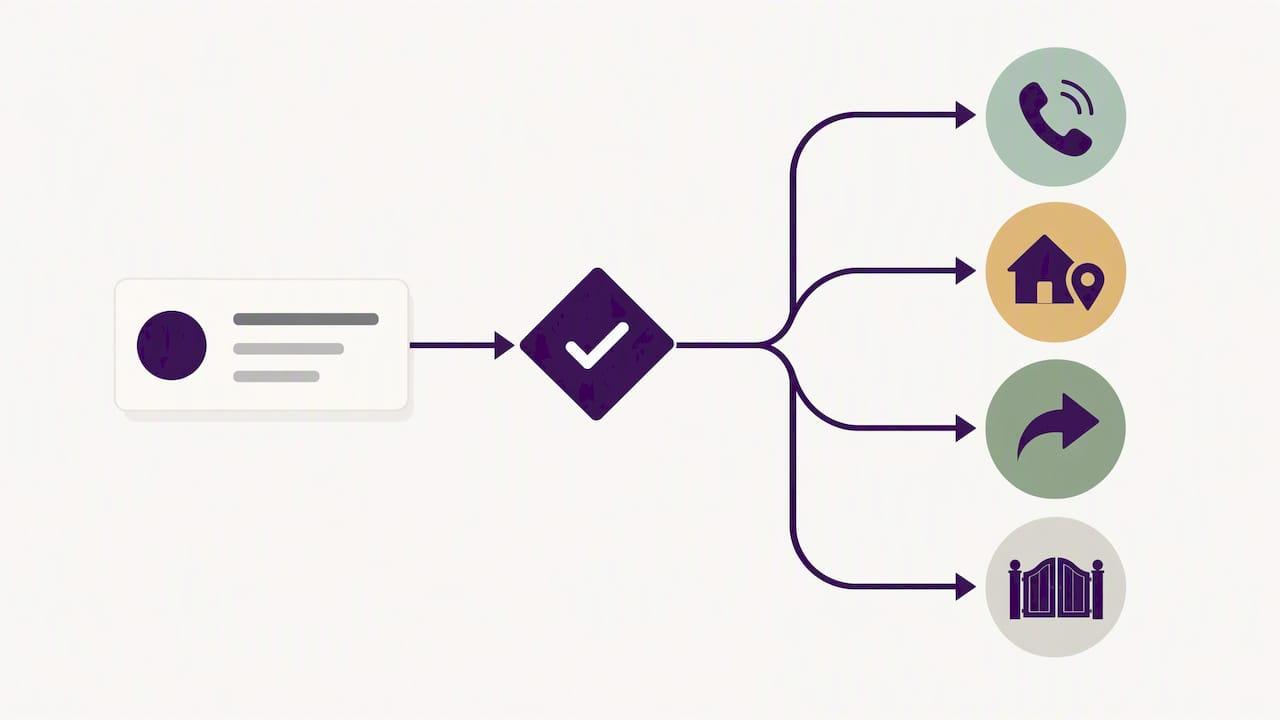
Write the answers where the next person will look
This is the part that makes it a handoff rather than a conversation. Whoever picks up the lead next, whether that’s you tomorrow or an estimator on Monday, shouldn’t have to ring the customer and ask the same questions. One record, one place, every answer in it.
Stage 3: Site visit, quote and follow-up
Once a lead is qualified, the job is to move it to a decision. Three habits keep this stage tight.
Give every lead a next action and a date. “Quote Thursday” is a next action. “Pending” isn’t.
State how long the quote is valid. It protects you when material prices move, and it gives the customer a reason to decide.
Book the follow-up when you send the quote, not later. Most quotes aren’t lost to a better competitor. They’re lost to nobody asking, “Did you get a chance to look at it?” Our notes on a follow-up cadence show a simple rhythm that doesn’t feel pushy.
Automation can help here, but keep your judgement in the loop. Reminders and templated check-ins make sure no quote is forgotten. Complex scopes, difficult customers and big-ticket jobs deserve a real phone call from you.
If you’re still building quotes by hand at night, the quote to invoice workflow shows how to speak a job into a quote and carry the same details through to the invoice without retyping.
Keep your pipeline stages honest
A lead’s status should say something true. A simple set of stages works for most trades:
- New: enquiry received, nobody has spoken to the customer.
- Contacted: you’ve made first conversation.
- Qualified: it passes your fit rules and has a next action.
- Quoted: quote sent, follow-up date set.
- Won or lost: with a reason recorded.
The trap is calling something “qualified” because it feels promising, or “quoted” when you don’t know whether the customer even opened the email. If a stage can’t be defined in one line, it’s too vague. A shared record with clear lifecycle stages also makes it obvious who owns each lead and where deals tend to stall.
Stage 4: From “yes” to a confirmed job
The customer says yes. This is the handoff most people think of, and it’s where good businesses look professional.
Before a job is called confirmed, check you have:
- A written acceptance of the quote or agreement, with the agreed scope and price.
- The deposit or payment terms noted, if you use them.
- A booked date or start window the customer has agreed to.
- Site access details: gate codes, parking, who will be home, pets.
- Any permits, approvals or strata or landlord permission needed.
- Materials and lead times ordered or flagged.
If something is missing, fix it now. Surprises are much more expensive on site than on the phone. And if the scope changes later, you’ll want a clear process for it; our change order guide covers how to do that without an argument.
Stage 5: The handoff to the person doing the work
When the job is confirmed, the person on the tools, whether that’s you on a different day, a leading hand or a subcontractor, needs a short handover. A good sales-to-delivery procedure, such as this one for trades and construction, includes customer background and key contacts, the agreed scope, deliverables and timeline, commitments made, risks or special requirements, supporting documents, the delivery owner and any open items.
For a trade business, that translates to a one-page job brief:
| Section | What goes in it |
|---|---|
| Who | Customer name, phone, on-site contact, preferred contact method |
| Where | Address, access notes, parking, hazards |
| What | Agreed scope in plain words, inclusions and exclusions |
| When | Start date, expected duration, any hard deadlines |
| How much | Quoted price, deposit status, variations pre-agreed |
| Promises | Anything you told the customer you’d do (“we’ll take the old unit away”) |
| Paperwork | Quote, photos, SWMS or safety documents, permits |
| Open items | Anything still unresolved, and who is chasing it |
Also name the delivery owner. When a job has two people who “sort of” own it, nobody does. Use job photos from the site visit so the crew can see what you saw, and keep work orders tracked so the job’s progress is visible without calling around.
At the end of the job, the same details flow into your records. Our guide to project handover documentation covers what to give the customer when the work is finished.
How to stop details getting lost
Most lost leads aren’t dramatic. They’re small, quiet failures. Here are the habits that prevent them.
One home for every lead
Pick one place where every enquiry lands, whether it came by phone, text, email, website or a referral. If a lead exists only in your head or a text thread, it’s already at risk.
One owner per stage
The silent failure in small businesses is an enquiry with no accountable person. Decide who owns new enquiries (often the office person or you), who owns technical qualification (the estimator or supervisor) and who owns delivery. Write it down.
One minimum set of facts
Decide the facts every lead must have before it can move to the next stage. If the address is missing, the lead can’t be marked qualified. Simple rules beat good intentions.
One exception path
Some jobs don’t fit the process: an emergency, a repeat customer who rings your mobile, a builder who sends a text at 6 pm. Have a quick way to get those into the system too, such as speaking a note into Hayley after the call.
Alerts for stalled leads
If a lead sits in one stage for too long, something should nudge you. That can be a calendar reminder, a task, or an automatic prompt. It doesn’t need to be fancy. It needs to exist.
What to do with leads that don’t convert
Not every enquiry becomes a job, and that’s fine. What matters is that each one ends cleanly.
- Unqualified: record the reason (outside your area, not your trade, budget mismatch), tell the customer politely, and close it. If you can, refer them to someone who can help.
- Not ready to book: set a follow-up date and a reason. A homeowner saving up for a bathroom reno might be a great job in four months.
- Declined your quote: ask for the reason, record it, and close it. Patterns show up quickly: price, timing, or a competitor who was quicker to respond.
- Gone quiet: follow up a couple of times, then close or move to a longer nurture list. Don’t leave them as “open” forever.
Recording reasons feels like admin until you notice you’ve lost four quotes in a row on timing, and realise your calendar is the problem, not your price.
A worked example: a gutter and roof repair enquiry
Here’s how the five handoffs look for a small roofing business with you, one office person and two crew.
- 9:40 am. A homeowner rings while you’re on a roof. Hayley answers, collects the suburb, the problem (water coming in near the downpipe), the urgency and a couple of photos by text. The enquiry lands in your record as New.
- 10:15 am. The office person reads it, sees it’s in your area and within your service, and calls to confirm access. It becomes Qualified, next action: site visit Wednesday.
- Wednesday. You inspect, take photos, and quote the same day. Quote validity is 14 days and a follow-up call is set for Friday.
- Friday. The customer says yes. You confirm scope, deposit and start date in writing.
- Monday. The crew gets a one-page brief: address, access, scope, photos, promises made and who to ring with questions.
Nothing in that sequence is complicated. The difference is that each step has an owner, a record and a next action.
Where Ask Hayley fits
Ask Hayley is a voice-first business management platform built for Australian tradies and small service businesses. You talk to Hayley instead of typing into forms or dashboards. Hayley answers calls you can’t take, pre-qualifies leads before they reach your inbox, and handles day-to-day admin like quotes, invoices, tasks and your calendar through natural voice prompts. It also integrates with Xero and AroFlo, so you aren’t running yet another disconnected app.
There are two core plans, Assistant and Office Manager, with optional add-ons including an AI Sales Agent and an AI Website Chatbot. If your handoffs are leaking at the first call or when you try to write things up at night, that’s the fastest place to start. We also build one-page websites, prepare tenders and write safety and compliance documentation. See what’s on offer at askhayley.com.au.
Our perspective
We talk to tradies who are brilliant at the work and tired of the paperwork around it. The pattern is almost always the same: the job itself goes well, but the bits between the enquiry and the job don’t. A call gets missed. A detail sits in someone’s head. A quote waits for a reminder that never comes.
We don’t think the answer is another dashboard. If you’re on a ladder, in a roof cavity or under a sink, you won’t open an app and fill in eight fields. That’s why we built Hayley around voice. The handoff should happen as you talk: you finish a site visit, say what you saw and what you quoted, and the record is there for whoever needs it next.
A process only works if it fits how you actually work. Start small. Pick the one handoff that hurts most, usually the first call or the quote follow-up, and fix that before you touch the rest.
— Hayley
FAQ
What is a lead to job handoff?
It’s the process of moving an enquiry through each stage until it becomes a confirmed job with a named owner and all the details the person doing the work needs. It includes several smaller handoffs: answering and logging the enquiry, qualifying it, quoting, following up, scheduling and briefing the crew.
What information should I capture from a new lead?
At a minimum: name, phone number, address or suburb, what the job involves, how urgent it is and who approves the work. Photos or video help for many trades. Add any safety or access risks so the estimator and crew aren’t surprised.
Who should own each stage of the handoff?
One named person per stage. Often that’s the office person or you for new enquiries, an estimator or supervisor for qualification and quoting, and a leading hand or the installer for delivery. Where you’re a sole trader, you own all of it, which is why a voice assistant to catch the first call and the notes is so useful.
How soon should I follow up a quote?
Set the follow-up date when you send the quote, and keep it consistent. Many tradies check in within a few days, then again near the quote’s expiry. Our follow-up cadence guide has a simple rhythm to start from.
What do I do with leads that say no or go quiet?
Record the reason and close them. If a customer simply isn’t ready, set a future follow-up date. Closing leads properly keeps your pipeline honest and shows you patterns, such as losing jobs on timing or price.
Sources
- Sales handover to delivery for trades and construction
- A simple field-to-office job handover for small trade businesses


