


The fastest way to stop missed calls is to combine call queue overflow routing with an overflow answering capture, either a live backup or a voice-first service, and back it with a simple consent message for recording. Done together, this setup catches leads you’d otherwise lose and keeps you on the right side of Australian privacy rules.
TL;DR:
- Setting up overflow with a backup call handler and consent message ensures more calls are answered and helps comply with Australian privacy laws.
- Automated overflow routing depends on your call volume, operating hours, and whether you want integrations with tools like CRM or Xero.
- Using voice-first capture and SMS triage can help tradies handle missed calls effectively without adding complexity to their workflows.
- Regular testing during busy hours and clear handback procedures improve overflow efficiency and customer experience.
- Budgeting mainly involves configuration costs and potential lost revenue from missed calls, so compare these before choosing an overflow solution.
Table of Contents
- What call overflow is and when it happens to your business
- Why managing overflow matters for revenue and reputation
- Common solutions explained and when to use each
- Setting up overflow in your phone system: a step-by-step checklist
- Australian compliance and privacy rules for call overflow
- How to choose the right overflow approach for your business
- A practitioner’s note on voice-first intake for tradies
- Examples of overflow strategies working in practice
- Cost considerations and budgeting for overflow solutions
- Where to start if you’re fixing this for the first time
- A voice-first way to handle the calls you can’t get to
- FAQ
- Sources
What call overflow is and when it happens to your business
Call overflow is what happens when a call can’t be answered by your usual line or team member and needs somewhere else to go. It’s different from voicemail or forwarding because overflow is about redirecting live calls to another resource before the caller gives up, not catching them after the fact.
For small trade and service businesses, overflow tends to strike at predictable moments:
- Two customers ring at once and one call goes unanswered while you’re on the other
- Peak periods like Monday mornings or after a storm flood your line
- Staff are on a job, on a break, or simply out of signal range
- Calls come in after hours or on weekends when nobody’s rostered on
Here’s the tricky part: an engaged or missed call often doesn’t show up clearly in your call logs. You might not even know you’ve lost the job until the customer rings a competitor instead.
Why managing overflow matters for revenue and reputation
A missed call isn’t just an inconvenience. For a trade business, it’s often a lost job, and the customer rarely waits around. They call the next name on the list.
Fixing overflow tends to show up quickly in your numbers: more calls answered, faster response times, and fewer customers who hang up before anyone picks up.
Response time is one of the biggest levers in whether a lead converts at all, which is why tracking it matters as much as fixing the technical setup, as our guidance on lead response time explains.
The KPIs worth watching are straightforward:
- Answer rate: the share of calls picked up versus total calls received
- Abandon rate: callers who hang up before reaching anyone
- Average speed to answer: how long callers wait before connecting
- Missed-call recovery rate: how many missed calls get a follow-up contact and convert
Common solutions explained and when to use each
There’s no single fix that suits every trade business. The right mix depends on your call volume, your hours, and how much you want to manage yourself.
- Call queue overflow groups: Most phone platforms let you set up overflow groups that route calls to secondary agents when your primary line is busy, using ring strategies like fixed order, longest idle, or simultaneous ringing, as RingCentral’s overflow feature documentation describes. This suits businesses with more than one person who can answer.
- Overflow answering services: A live backup service picks up the second call when your main line is engaged, typically on a flat-priced plan, and works alongside your existing phone setup rather than replacing it. Good for solo operators who need a human safety net.
- Auto attendant or IVR, virtual receptionists, forwarding, simultaneous ringing: These route or screen calls automatically, useful when you want structure without hiring anyone new.
- SMS or text triage and voicemail-to-text: Turns a missed call into a text message so you can respond on your own time, which suits tradies who can’t always talk on site.
- AI-assisted voice agents: These can answer, pre-qualify and capture details without a human on the line, but they need a mandatory human review step before any output goes back to a customer, particularly for anything sensitive.
Setting up overflow in your phone system: a step-by-step checklist
Getting overflow working properly isn’t complicated, but it does need a bit of planning so nothing falls through the gaps.
- Define your trigger rules. Decide how many seconds a call rings before it overflows, and whether overflow members ring in fixed order or simultaneously.
- Build your overflow groups. Add the people, service or AI agent who should pick up the second call, with a clear ring strategy.
- Connect your integrations. Link SMS notifications, your CRM, and your field-job system, noting how captured details sync with tools like Xero or AroFlo.
- Set handback rules. Decide how the overflow handler passes the call back, including a short summary of caller name, reason, urgency and preferred callback time.
- Add wrap-up notifications. Make sure someone gets pinged the moment a call is handled, so nothing sits unanswered.
- Test it properly. Run a short verification script: call in while the main line is busy, confirm the overflow group rings, check the CRM entry lands correctly, and test the consent message across your state’s rules, a method similar to the test steps outlined by CallCentreHelper’s overflow guide.
Pro Tip: Test your overflow setup during a genuinely busy hour, not a quiet one. Quiet-hour tests miss the exact problems overflow is meant to solve.
Our phone answering scripts for tradies are a handy starting point for wording your consent message and handback notes.
Australian compliance and privacy rules for call overflow
Recording rules differ by state and territory, which makes a blanket approach risky. The simplest and fastest compliance fix across Australian jurisdictions is an automatic consent message at the start of a recorded call, as outlined in Byteway’s 2026 guide to phone system compliance.
If you’re using AI to answer or triage calls, the Privacy Act and Australian Privacy Principles come into play too:
- Disclose when AI is involved in handling a call or message
- Minimise the customer data fed into any AI prompt
- Review AI-generated outputs before they reach a customer, treating them as drafts rather than finished answers, in line with OAIC guidance on AI use by small business
- Prefer Australian data hosting where you have the choice, and set a clear retention period for call recordings and transcripts
Keep access logs for who can view call data, and avoid fully automating anything involving sensitive personal information without a human checkpoint.
How to choose the right overflow approach for your business
Match your approach to your actual call pattern, not what sounds impressive. A sparky who gets the occasional overlap needs something simpler than a plumbing business fielding emergency calls at 2am.
Work through these questions before committing to anything:
- How many calls overlap during your busiest hour, and how often does that happen?
- What are your real operating hours, including after-hours emergency work?
- What’s your budget, and does it need to scale with call volume?
- Does the tool need to talk to your existing CRM, Xero, or AroFlo setup?
When you’re comparing vendors, ask about Australian data hosting, consent and recording support, integration options, service level agreements, and what reporting you’ll actually see. Red flags worth walking away from include offshore-only data hosting with no Australian option, no human review step for AI outputs, and vague or missing escalation paths when something needs a real person.
A practitioner’s note on voice-first intake for tradies
Voice-first capture suits trade work because it doesn’t ask you to stop and type. You talk, the system listens, and it pre-qualifies the lead while you’re still holding a drill.
That’s the gap Ask Hayley was built to close: picking up when you can’t, asking the right questions, and feeding the details straight into your work-order tracking and follow-up cadence so nothing needs re-typing later.
Pro Tip: Run a one-week test where every missed call gets a voice-first capture and a same-day follow-up text. Compare your answer rate before and after.
Our missed call recovery guide has more experiments worth trying.
Examples of overflow strategies working in practice
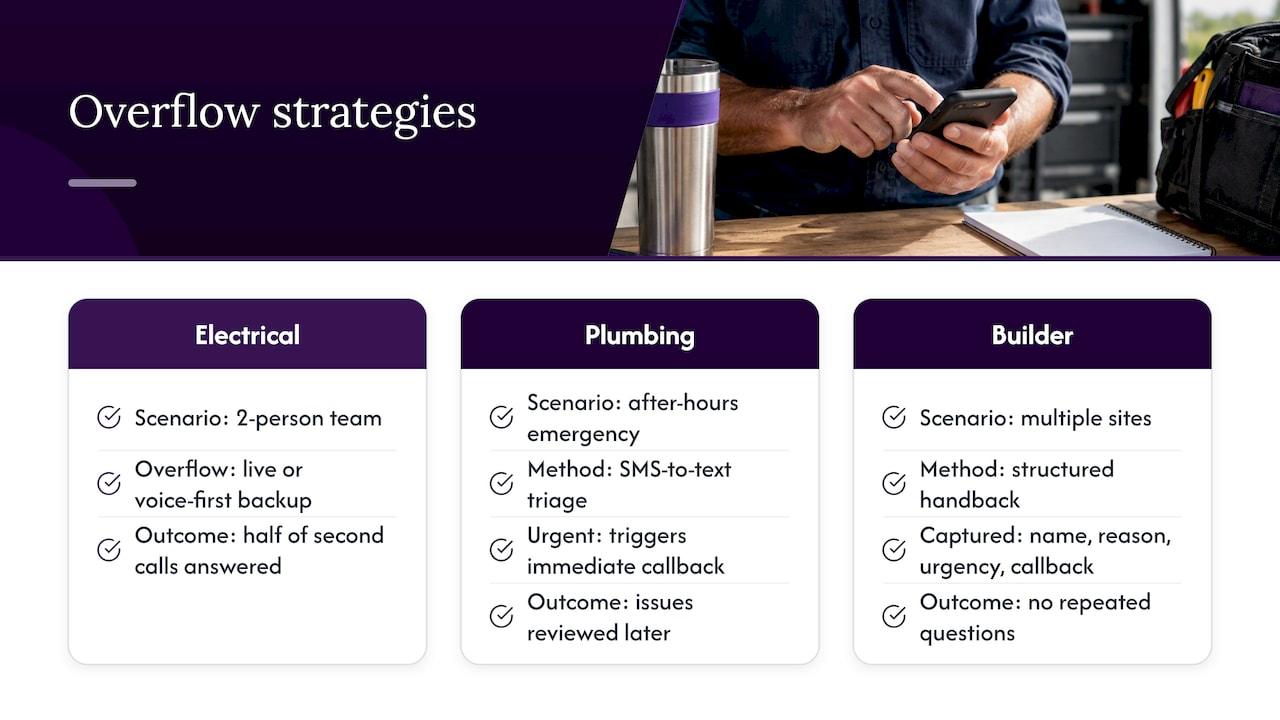
Picture a two-person electrical business where both tradies are often on tools at the same time. Every call that rings out used to go to voicemail, and most customers never left a message, they just rang the next electrician on the list. Adding a simple overflow group with a live or voice-first backup meant every second call got answered instead of ignored.
A plumbing business running after-hours emergency work faces a different problem: calls at 11pm that need a quick triage, not a full conversation. SMS-to-text triage lets the customer describe the issue in a text, which gets reviewed first thing, while anything marked urgent triggers an immediate callback.
For a builder juggling multiple sites, the challenge is less about missed calls and more about losing context. A tidy handback process, where the overflow handler notes the caller’s name, the reason for the call, how urgent it is, and when they’d like a callback, means the builder isn’t re-asking questions the customer already answered. That single habit, tagging the CRM properly at handback, tends to make the biggest difference to how smoothly overflow actually works day to day.
None of these fixes needed an expensive system overhaul. They needed a clear rule for what happens to the second call, and a way to make sure it got answered by someone or something that could capture the details properly.
Cost considerations and budgeting for overflow solutions
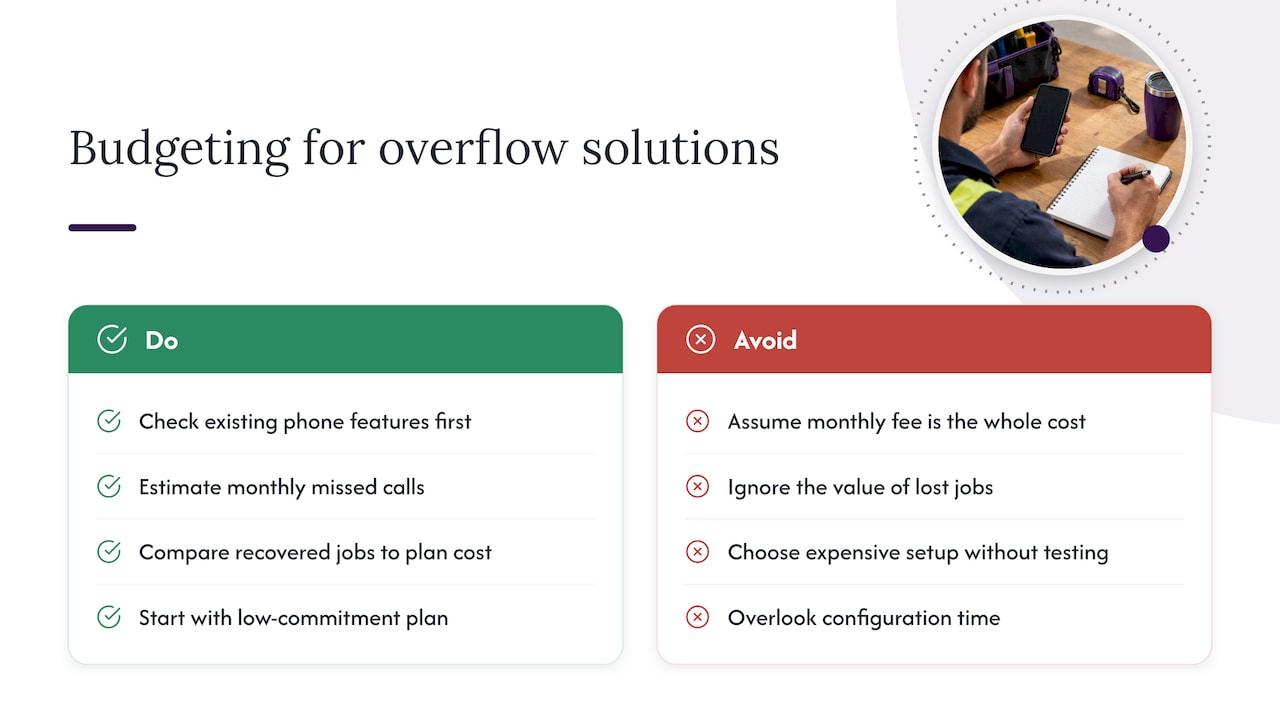
Budgeting for overflow doesn’t have to mean a big upfront spend. Most of the building blocks, queue overflow groups, SMS triage, voicemail-to-text, come bundled into phone systems you may already be paying for, so the first cost is often just configuration time.
Live overflow answering services are commonly sold as flat-priced plans, which makes budgeting predictable if you know roughly how many overflow calls you get in a typical month. Voice-first AI capture tends to sit on a subscription model, scaling with usage rather than requiring a big setup fee.
The real cost to weigh isn’t the monthly fee, it’s the cost of the jobs you’re currently losing. If a missed call has a reasonable chance of becoming a job, even a handful of recovered calls a month can outweigh what you’d spend on an overflow solution. Start by estimating how many calls you’re missing now, then compare that against the price of whichever overflow option you’re considering before committing to a plan.
Where to start if you’re fixing this for the first time
If you only do one thing this month, make it two things: turn on an automatic consent message for recorded calls, and set up a single overflow group so the second call always goes somewhere. Everything else, SMS triage, voice-first capture, CRM integration, can be layered on once that baseline is working. Log your answer rate for one week before and after, and let the numbers tell you what to fix next.
— Hayley
A voice-first way to handle the calls you can’t get to
We built Ask Hayley around the reality of trade work: hands full, on a roof or under a sink, with no time to sit at a screen. The system can answer calls you miss, pre-qualify leads by voice, and feed the details into your existing workflow, with no typing or new app to learn.
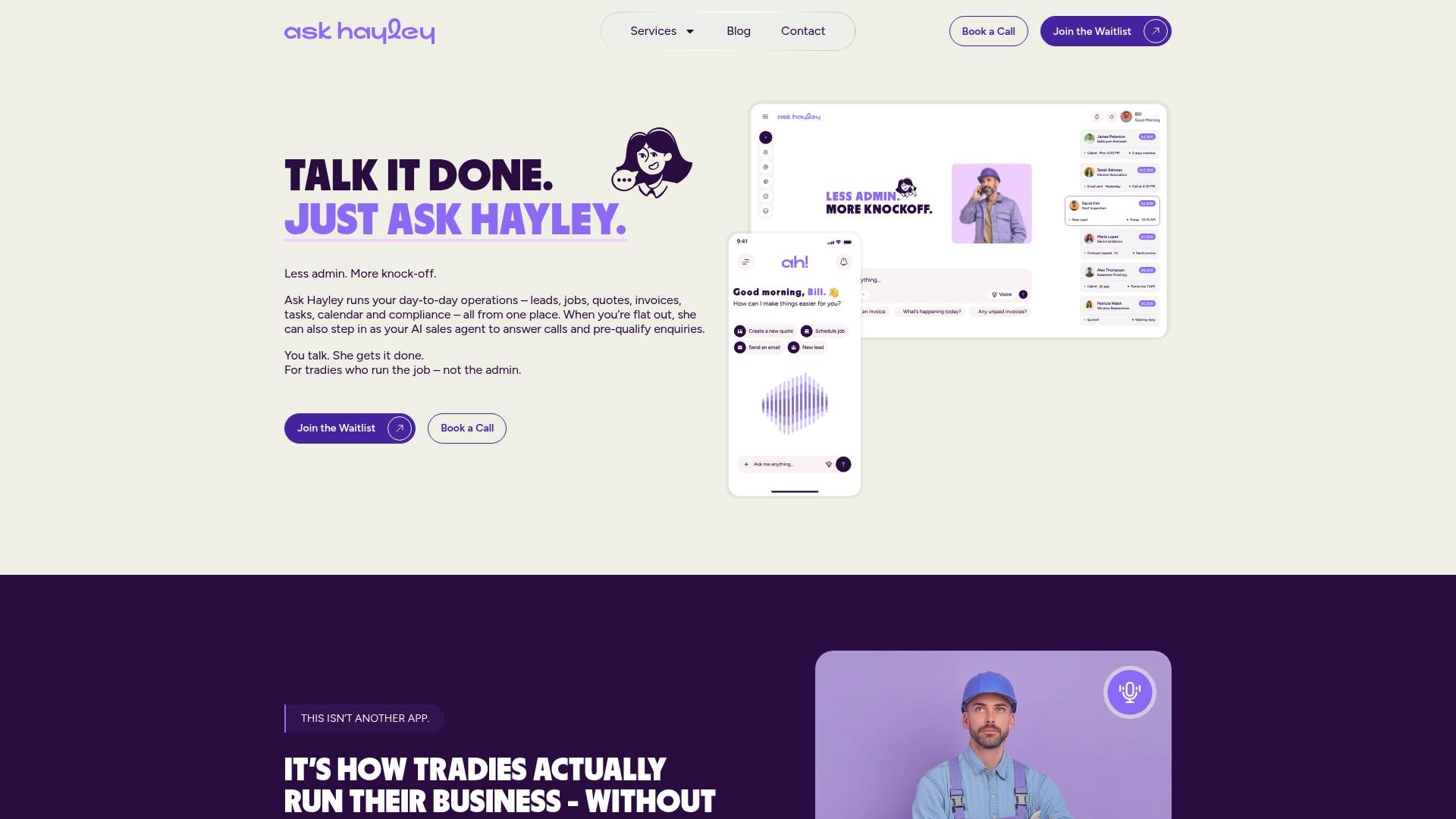
If you’d rather talk through how voice-first capture would fit your business than configure overflow settings yourself, visit Ask Hayley and book a demo to see it in action.
FAQ
How can I block spam calls in Australia?
Most Australian telcos offer call screening or spam-blocking features you can switch on through your carrier account, and the ACMA maintains broader rules requiring telcos to block known scam numbers. Pairing this with an auto attendant that filters unrecognised numbers before they reach your overflow queue also helps reduce noise.
What counts as a call centre?
A call centre generally refers to any dedicated setup, in-house or outsourced, handling a volume of inbound or outbound calls using queues, routing and reporting tools. A small business using overflow groups and a live or voice-first backup is running a lightweight version of the same idea, just scaled to its own call volume.
What are the best small business phone systems available in Australia?
The right system depends on your call volume, budget and whether you need overflow groups, SMS triage or AI capture built in, rather than any single product suiting every business. Look for Australian hosting, consent message support, and integration with tools like Xero or AroFlo when comparing options, as outlined in RingCentral’s overflow feature support.
How do I turn off call forwarding in Australia?
Call forwarding is usually switched off through your phone system’s settings or by dialling a simple deactivation code provided by your carrier, which varies by provider. If forwarding is set up through a cloud phone platform rather than your carrier directly, you’ll typically disable it in the platform’s call routing settings instead.
Do I need consent to record business calls in Australia?
Yes, recording rules vary by state and territory, and several require all parties to consent before a call is recorded. An automatic consent message at the start of the call is the simplest way to stay compliant across jurisdictions, as detailed in Byteway’s compliance guide.
Sources
- OAIC AI guidance: what it means for small business
- Is your business phone system compliant? 2026 AU guide
- RingCentral support: call queue overflow feature


