


First call answer rate measures the share of inbound calls your business answers, and it sits at the heart of how many leads you actually get to speak to. Australian contact centres report an average voice abandonment rate near 8%, meaning the rest get answered, according to the 2024 Australian contact centre industry best practice report. For tradies and small service businesses, every missed call is a lead that might ring a competitor next.
TL;DR:
- Track answer rate alongside service level, abandonment, and first call resolution: the 80/20 target measures speed, while external FCR benchmarks sit around 70% to 75%.
- Measure over two to four weeks, remove test calls and spam, align reporting cutoffs, and track queued calls separately rather than quietly excluding them.
- Compare your results with businesses of similar size and call volume; ContactBabel’s mean abandonment exceeded 10%, while its median was lower.
- Solo operators should add voice first intake or human overflow; small teams with long queues should roster peak hours and shorten menus.
- Estimate recovered revenue from your own missed calls, conversion rate, and average job value, then test one fix for four to six weeks before expanding.
Table of Contents
- What first call answer rate actually measures
- Australian benchmarks: where your answer rate should sit
- How to measure first call answer rate without fooling yourself
- Practical tactics to lift your answer rate
- Setting targets and proving the ROI
- How Ask Hayley protects answer rate for tradies on the tools
- Why being on the tools makes answer rate harder to control
- Making answer rate improvements stick in your existing systems
- Why training and culture matter as much as technology
- Balancing customer experience and cost: an expert checklist
- How Ask Hayley can reduce missed-call leakage
- FAQ
- Sources
What first call answer rate actually measures
First call answer rate is simple on paper: the number of inbound calls you answer, divided by the total number of calls offered to your line, expressed as a percentage. It sounds straightforward, but it gets confused with a handful of related metrics that measure different things entirely.
Service level is the one people mix up most. Where answer rate just tells you how many calls got picked up, service level tells you how fast. The common Australian target is “80/20,” meaning 80% of calls answered within 20 seconds, a benchmark widely used across Australian contact centres according to the 2023 Australian contact centre industry best practice report. Some operations use an 80/30 variant. You can have a high answer rate and a poor service level if calls are getting through, just slowly, which matters because customers who wait too long often hang up before anyone picks up.
Abandonment rate is the mirror image of answer rate: the percentage of callers who give up before being answered. If your answer rate is 88%, your abandonment rate is roughly 12%, though the two aren’t always perfectly inverse once you account for calls still in queue at the end of a measurement period.
First Call Resolution, or FCR, measures something different again: whether the customer’s issue got sorted in that one call, without a callback or transfer. You can answer every call you receive and still have poor FCR if your team keeps having to chase up jobs, reschedule, or escalate. According to the FCR Comprehensive Guide from SQM, a good FCR benchmark sits around 70% to 75% under external measurement, with 80%+ considered world-class and rare.
Here’s how the four metrics differ in practice:
- Answer rate tells you how many calls got through at all.
- Service level tells you how fast calls were answered against a time target.
- Abandonment rate tells you how many callers gave up before reaching anyone.
- First Call Resolution tells you whether the call actually solved the customer’s problem.
Each metric answers a different question, and the useful move is reading them together rather than picking a favourite. A tradie business that only tracks answer rate might miss that calls are being answered too slowly to retain impatient customers. One that only tracks FCR might miss that a chunk of calls are never reaching anyone in the first place. Treat answer rate as your first filter: it tells you whether you’re even in the conversation before you worry about how well that conversation goes.
Australian benchmarks: where your answer rate should sit
Knowing the national picture helps you judge whether your own numbers are a problem or just normal variation. The 2024 Australian contact centre industry best practice report found the industry average voice abandonment rate sitting around 8%, with the average speed to answer rising to about 115 seconds in 2024. That implies an average answer rate in the low nineties for voice calls across the sector, though speed to answer climbing to nearly two minutes shows plenty of customers are waiting longer than they’d like even when they do eventually get through.
An abandonment rate of about 8% across Australian contact centres means roughly 92% of calls are answered on average, but that average hides wide variation between sectors and business sizes, according to the 2024 best practice report.
The ContactBabel 2023-24 ANZ Decision-Makers’ Guide adds useful context with a slightly different picture: a mean abandonment rate just over 10%, with the median notably lower. That gap between mean and median matters more than it looks. A handful of large, under-resourced queues can drag the average up even though most businesses are performing better than that headline figure suggests. If you’re a five-person plumbing outfit comparing yourself to a national mean built partly from large retail call centres, you’re not comparing like with like.
That’s the real lesson from the Australian data: pick your comparator carefully.
- Compare against businesses of similar size and call volume, not just the same industry.
- Favour median figures over mean figures when judging where you sit, since a skewed mean can make typical performance look worse (or better) than it is.
- Treat any single benchmark as a starting point, not a verdict, until you’ve checked it against a few data points from your own sector.
A sole-trader electrician fielding 20 calls a week has a completely different risk profile to a 20-seat trade services call centre. The electrician loses a customer the moment a call goes unanswered because there’s no second line ringing. The larger operation has queuing, overflow, and rostering options the solo operator doesn’t. Both should care about answer rate, but the levers available to fix a poor one look very different.
The practical takeaway: use the ACXPA and ContactBabel figures as a reality check, not a scoreboard.
How to measure first call answer rate without fooling yourself
Getting the number right matters more than people assume, because a flawed measurement method can make a struggling line look fine, or a decent one look broken. Start with clean definitions. An offered call is any inbound call that reaches your phone system, including ones that are abandoned or diverted. An answered call is one a human (or your intake system) actually picks up and engages with. An abandoned call is one the caller ends before anyone answers.
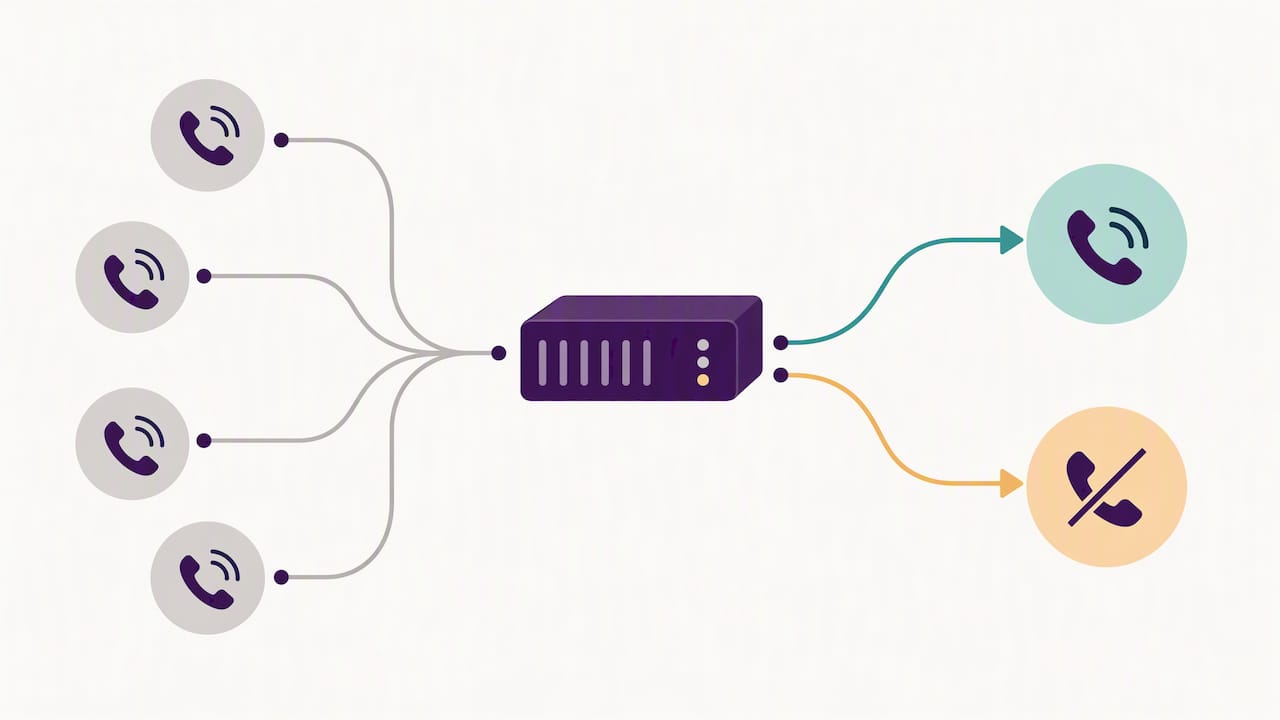
A sensible sampling window is two to four weeks. Shorter than that, you’re reacting to noise. One bad Monday can wreck a weekly figure. Longer than a month and you risk the number smoothing over real seasonal spikes, which matter a lot for trades with busy periods tied to weather or financial-year deadlines.
The formula itself is simple: answered calls divided by offered calls, multiplied by 100. The traps are in what counts as “offered” and “answered.”
- Confirm your offered-call count excludes noise. Strip out test calls, IVR health checks, and known spam numbers before you calculate anything, or your denominator will be inflated.
- Check that callbacks aren’t double-counted as answered. If your system logs an automated callback as a second “call,” make sure it isn’t also being logged as the original call being answered.
- Align your time windows across systems. If your phone system and your CRM report on different cut-off times, your weekly totals won’t match, and you’ll be chasing a discrepancy that doesn’t exist.
- Include the queue tail. Calls still waiting when your reporting period ends should be tracked separately, not silently dropped from either the offered or answered count.
- Decide whether voicemail counts as answered. Many businesses count a voicemail as a “miss” even though the system picked up, because the customer didn’t get to speak to anyone, which is the outcome that actually matters commercially.
These audit steps follow the same approach the 2024 best practice report recommends for validating call-log data before trusting it as a management metric.
There’s also a choice between internal and external measurement. Internal measurement relies on your own phone system logs and call records, which is fast and cheap but can overstate how well things are actually going. External measurement, typically post-call surveys or independent audits, captures what the customer experienced rather than what the system recorded. This distinction matters more for First Call Resolution than for raw answer rate, but the principle carries across: according to Wikipedia’s overview of First Call Resolution, internal FCR measurement can overstate performance by 10 to 20% compared with external post-call survey methods, because customers and staff don’t always agree on whether a problem was genuinely resolved. The same caution applies to interpreting answer rate when the only measurement comes from inside your own phone system.
Pro Tip: Pull your call logs weekly for the first month you start tracking answer rate, even if your long-term reporting window is monthly. It’s the fastest way to catch a measurement error before it skews a quarter’s worth of data.
Practical tactics to lift your answer rate
Once you know your real number, the fixes split into four areas: staffing, routing, overflow, and recovery. Most Australian tradie businesses get more value from tweaking the first and third than from any single piece of technology.
Staffing and rostering is the obvious lever, but it needs data first. Pull your call volume by hour and day for a month and you’ll usually find peaks are concentrated in short, predictable windows, often early morning before jobs start and late afternoon as jobs wrap up. A solo operator or two-person team can’t staff a dedicated phone desk, but a split shift where one person checks calls at set intervals, or a simple on-call rotation between partners, can close a surprising amount of the gap without adding headcount.
Routing and IVR design either helps or actively drives abandonment. A long automated menu before a caller reaches a human is one of the more common ways trade businesses lose calls they’d otherwise answer. Keep menus short, prioritise urgent-sounding enquiries (a burst pipe shouldn’t wait behind a billing question), and set clear overflow rules so calls that aren’t picked up within a few rings divert somewhere useful rather than ringing out.
Overflow and intake is where small businesses have the most room to improve quickly. Human overflow, a partner, a family member, or a shared answering arrangement, works for very small teams. Voice-first AI intake is increasingly the practical middle ground for solo and small operators who can’t staff a phone desk but need every call captured and triaged, even when their hands are full on a tool or up a ladder. Fast SMS or email follow-up for anything that does slip through closes the loop.
Voicemail and missed-call recovery deserves its own discipline. A missed call isn’t a lost lead if you call back inside a tight window. Set an internal response SLA (same business day, or within the hour for anything flagged urgent), use automated callback prompts where your system supports them, and keep a short template ready so the follow-up doesn’t depend on someone remembering the right words under pressure. Speed matters here: research on B2B lead response times shows leads contacted within a short window are substantially more likely to qualify than those contacted hours later, a pattern that holds for trade enquiries as much as any other sales lead. Our guide to missed call recovery for Australian tradies covers specific follow-up sequences you can set up once and reuse.
Here’s how the same set of fixes plays out differently depending on team size:
| Business size | Typical gap | Most effective first fix | Secondary fix |
|---|---|---|---|
| 1 to 5 person tradie | Calls missed entirely while on tools or driving | Voice-first intake or overflow so no call goes unanswered | SMS follow-up template for anything missed |
| few-person service business | Calls answered but queued too long, driving abandonment | Rostered coverage across peak call windows | Shorter IVR menu with priority routing for urgent jobs |
A one-person electrical business that starts using overflow coverage for calls received while on a job can move from missing roughly a third of inbound calls to missing a handful, simply by making sure something always picks up. A 15-person plumbing outfit with a shared office line often finds the bigger win in trimming a four-option phone menu down to two and adding a dedicated overflow number for anything not answered in four rings, which does more for abandonment than hiring another receptionist would.
Setting targets and proving the ROI
Pick your target based on where you’re starting, not where you’d like to be in an ideal world. This approach mirrors the pace of improvement the SQM FCR guide describes for First Call Resolution gains, and the same caution applies: a jump from 80% to 95% answer rate in a month is a sign you fixed a fault, not a sign of a new normal.
Translating the improvement into commercial terms is what makes the investment easy to justify to yourself or a business partner.
- Work out your current missed-call volume. If you receive 100 calls a week and answer 88, that’s 12 missed calls weekly, or roughly 48 a month.
- Estimate how many of those would have converted to a job. Use your own historical conversion rate from answered enquiries as the basis, since that’s the number you actually have evidence for.
- Multiply recovered leads by your average job value. If even a third of those 48 missed calls would have converted and your average job is worth a few hundred dollars, the monthly revenue at stake adds up quickly even for a small operation.
- Weigh that recovered revenue against the cost of the fix. ACXPA’s guidance on abandonment is blunt about this: improving answer rate only makes sense when the recovered calls generate more value than the cost of getting there, so run the numbers before committing to extra staff or a new system.
A recovered-leads calculation using your own missed-call count and average job value turns an abstract KPI into a dollar figure you can weigh against the cost of fixing it, a cost-benefit approach ACXPA recommends rather than chasing the metric for its own sake.
For dashboards, keep it simple: track answer rate and abandonment rate daily, service level weekly, and FCR monthly since it needs enough volume to be statistically meaningful. Set an alert if daily abandonment climbs above your rolling average by more than a few points, that’s usually the first sign something in your rostering or routing has broken.
How Ask Hayley protects answer rate for tradies on the tools
The practical problem for most trade businesses isn’t a lack of interest in fixing their answer rate, it’s that nobody is free to sit by a phone. We built Ask Hayley around that exact constraint: a voice-first assistant that answers calls when you can’t, without needing you to open an app, check a dashboard, or type anything while your hands are full.
When a call comes in and you’re unavailable, Hayley picks it up, has a real conversation with the caller, and pre-qualifies the enquiry before it reaches your inbox. That means by the time you get a notification, you already know whether it’s a job worth chasing, a quote request, or something that can wait. For a solo operator, that’s the difference between a missed call going nowhere and a missed call becoming a logged, triaged lead.
What that tends to change in practice:
- A higher share of inbound calls get answered, because overflow is handled automatically rather than depending on someone being near a phone.
- Lead triage happens faster, since enquiries arrive pre-qualified rather than as a raw voicemail to decode later.
- Follow-up becomes more consistent, because every call is logged the same way instead of depending on memory or handwritten notes.
It fits the reality of trade work specifically: no dashboard to check between jobs, no typing required on a ladder or under a sink, just a voice-first layer that sits behind your existing number and catches what you’d otherwise lose.
Why being on the tools makes answer rate harder to control
Office-based call centres can roster shifts around a predictable queue. Trade businesses can’t, because the person who’d normally answer the phone is usually the person wiring a switchboard or under a vehicle. That’s the core reason first call answer rate tends to run lower for mobile trades than for desk-based service teams: the caller and the tradie are rarely in the same place at the same time.
Mobile reception adds its own friction. A call that goes to voicemail because you’re in a basement with no signal looks identical in your call logs to one you simply chose not to answer, but the fix is different. Patchy coverage calls for overflow and callback systems that don’t depend on you personally picking up, while a capacity problem calls for rostering changes.
On-site noise and safety are a quieter factor too. Answering a call mid-task on power tools or at height isn’t just inconvenient, it’s a genuine safety issue, which is part of why so many tradies let calls ring out rather than stop what they’re doing. Any fix that assumes you’ll just “answer more calls” ignores that constraint. The more realistic fix is making sure something else answers reliably when you physically can’t, so the job you’re doing safely doesn’t cost you the next one.
Making answer rate improvements stick in your existing systems
A better answer rate doesn’t mean much if the leads it captures fall through the cracks afterwards. The fixes work best when they plug into whatever you’re already using to run quotes, jobs, and invoicing, rather than becoming a separate system you have to check.
If a call gets answered but the details sit in a notebook or a memory until you’re back at the ute, you’ve solved the first problem and created a second one. The practical approach is making sure answered calls flow straight into whatever you use to track leads and jobs, whether that’s a shared calendar, a job management tool, or accounting software like Xero. Our piece on field service KPIs looks at how phone metrics and field utilisation numbers can sit in the same view, so you’re not juggling two separate reports to understand how your week actually went.
Overflow and follow-up tools are only worth adding if they reduce admin rather than adding a new screen to check. A call overflow setup that logs enquiries automatically into your existing workflow, rather than a standalone inbox, saves the double handling that usually kills good intentions around answer rate within a few weeks.
Why training and culture matter as much as technology
Technology fixes the mechanics of answering a call. What happens once someone picks up still comes down to the person on the other end. A team that’s been trained to ask the right two or three questions in the first 30 seconds converts more enquiries than one that just takes a name and number, regardless of how good your answer rate looks on a dashboard.
Culture plays into this more than most businesses expect. If answering the phone is treated as an interruption to the “real work,” staff will quietly let calls slide, no matter what targets are set. If picking up the phone is treated as part of the job, that attitude shows up in the numbers without any extra system being bought.
Simple habits help: a short script for the first 15 seconds of a call, a shared understanding of what counts as urgent, and a quick weekly check-in on missed calls so patterns get caught early rather than at the end of a bad month. None of that requires new software, just a consistent expectation that every call is worth answering properly.
Balancing customer experience and cost: an expert checklist
Chasing a perfect answer rate isn’t always the right call. Past a certain point, the cost of adding staff or technology outpaces the revenue those extra answered calls bring in, and that’s a legitimate business decision rather than a failure.
Before investing further, ask three questions: is the gap actually costing us jobs, or just making us feel uneasy about a number. Would the fix be staffing, process, or technology, and which of those matches the size of the problem. And have we checked service level and FCR alongside answer rate, since a high answer rate with poor resolution just moves the problem downstream.
The trap worth naming directly is treating answer rate as the whole story. Answer rate tells you whether you’re in the conversation, not whether you’re winning it.
The sensible governance step is small and repeatable: measure your current number properly, pilot one change for a month, four to six weeks is enough to see a real pattern, and check whether the recovered revenue justified the cost before rolling it out further or trying something else.
— Hayley
How Ask Hayley can reduce missed-call leakage
If you’ve read this far, you already know the fix for a shaky answer rate rarely needs another full-time hire, it needs something reliable catching the calls you physically can’t take. That’s the gap we built Ask Hayley to close: a voice-first assistant that answers when you’re on the tools, pre-qualifies the enquiry, and gets the details into your workflow without you touching a screen.
Whether you’re a solo operator missing calls while driving between jobs, or a small team losing leads during your busiest hours, Hayley sits behind your existing number and makes sure every call gets a response. You can see how it works and what’s included on the Ask Hayley homepage, and get a feel for whether it fits the way your business actually runs before you change anything else.
FAQ
What is a good first call resolution rate?
A good First Call Resolution rate typically sits around 70% to 75% under external post-call survey measurement, according to the SQM FCR guide. Anything above 80% is considered world class and is uncommon, while internal measurement methods can overstate the true figure by 10 to 20% compared with external surveys, per Wikipedia’s overview of FCR.
What is the 80/20 rule in call centers?
The 80/20 rule is a service level target meaning 80% of calls are answered within 20 seconds, one of the most commonly used benchmarks in Australian contact centres according to the 2023 best practice report.
What is a good answer rate for a call center?
Australian contact centres average an abandonment rate of about 8%, which implies a typical answer rate in the low nineties, according to the 2024 best practice report. Small trade and service businesses should compare against similarly sized operations rather than national averages, since mean figures can be skewed by larger queues.
How much do 1300 calls cost in Australia?
Pricing for premium local numbers in Australia varies by provider, call volume, and plan, and isn’t published as a single standard rate, so it’s worth checking current quotes directly with phone and telecommunications providers. The more useful number to focus on first is your current answer rate and missed-call volume, since that tells you whether a premium number or a different overflow solution is the better fix for your business.
What causes a low first call answer rate for tradies?
The most common cause is simply being unavailable to answer because you’re on the tools, driving, or in an area with poor mobile reception. Long IVR menus, no overflow coverage, and under-rostering during predictable peak call windows are the other frequent causes among small Australian service businesses.
Sources
- 2024 Australian contact centre industry best practice report
- The 2023-24 Australian and New Zealand contact centre decision‑makers’ guide (executive summary)
- FIRST CALL RESOLUTION: Comprehensive Guide (SQM)
- First call resolution — Wikipedia


