


The best customer intake questions for a trade business are the few that let you decide three things fast: is this job in your area and your trade, how urgent is it, and what is the next step (a booking, a quote visit or a referral). Everything else can wait. Ask for a name, a number, a suburb, a description of the problem and a time that suits, and you have enough to move.
Most intake advice online is written for clinics, law firms and counsellors, and it shows. Those forms run to pages. You are standing on a roof, under a sink or in a ute, and the caller wants to know if you can help. This guide gives you a short, practical question set for the trades, explains what you can safely leave for later, and covers the privacy basics that apply in Australia.
TL;DR
- Ask six things on the first contact: who, where, what, how urgent, access and the best time. Add trade-specific questions only when they change the quote or the booking.
- Do not turn a friendly call into a form-filling exercise. Aim for the booking or the quote visit, and collect the rest afterwards.
- Only collect personal information you actually need, and tell people why. Even if your turnover is under $3 million, following the Australian Privacy Principles is recommended.
- Missed calls are missed intake. Have a script, a voicemail or an answering option so the same questions get asked when you can’t pick up.
Table of Contents
- What a customer intake actually is
- The core intake questions every trade should ask
- Trade-specific questions worth adding
- What to leave until later
- Privacy: what you can and can’t collect
- Making the call feel natural
- What about the calls you can’t answer?
- Intake on your website
- Our view: intake should happen where you work
- Where Ask Hayley fits
- A simple intake checklist to copy
- FAQ
- Sources
What a customer intake actually is
Customer intake is the first structured exchange between you and a new enquiry. It might be a phone call, a website form, a text or a message through a marketplace. The goal is not to collect data. The goal is to qualify the job and agree the next step.
A good intake does three jobs at once:
- Filters. It tells you quickly whether the job is inside your trade, licence, service area and capacity.
- Prepares. It gives you enough detail to arrive with the right tools, parts and time allowance, or to price roughly.
- Sets expectations. The customer knows what happens next and when.
If a question does none of those, it probably doesn’t belong in the first conversation.
The core intake questions every trade should ask
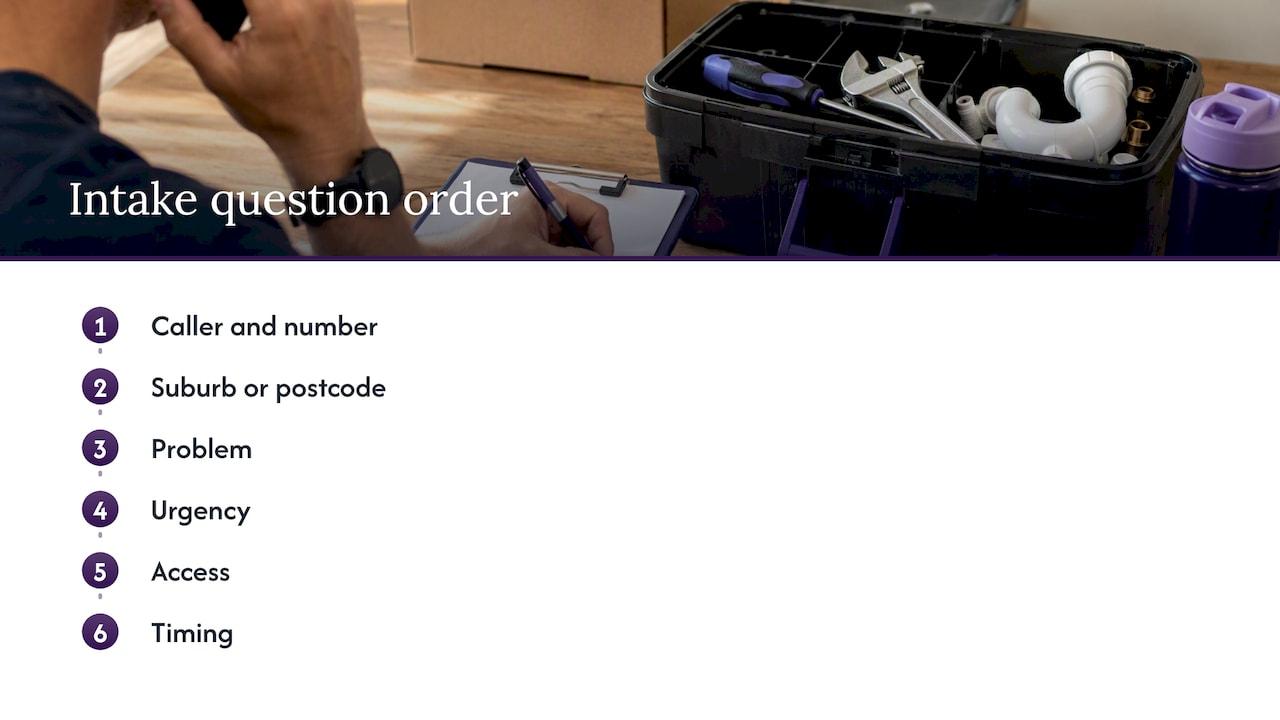
These work for plumbers, sparkies, roofers, painters, landscapers and most others. Keep them in this order, because it feels like a conversation rather than an interrogation.
1. Who am I speaking with, and what’s the best number?
A first name and a mobile number are the minimum. If the call drops, you can call back. Skip the surname, email and full address until the job is going ahead.
2. What’s the suburb or postcode?
This is the fastest filter you have. If it’s outside your service area, you can say so politely in the first 30 seconds and save both of you time. A full street address can wait until you’re booking.
3. What’s going on?
Let the customer describe it in their own words, then ask one follow-up. “Where is it happening?” or “How long has it been doing that?” usually does the job. Resist the urge to run a checklist.
4. How urgent is it?
Is water running, power off, a tree on a fence or a gutter overflowing right now? Or is it a tidy-up they want done in the next month? Urgency decides whether this is an emergency call-out, a next-available booking or a quote for later in the schedule.
5. Is there anything about access we should know?
Locked gates, dogs, strata or body corporate rules, tenants who need notice, steep driveways, a second storey. Access surprises cost more tradies time than almost any technical detail.
6. When suits you?
End on the next step. “I can come Thursday morning or Friday after lunch, which works?” gets a booking. “We’ll be in touch” gets a competitor.
Trade-specific questions worth adding
Only add a question if the answer changes your price, your tools or your safety. Here are examples by trade. Treat them as starting points and trim to suit your business.
| Trade | Useful extra questions | Why it matters |
|---|---|---|
| Plumber | Hot or cold water? Is the water isolated? Photo of the fixture? | Decides urgency and whether you bring parts |
| Electrician | Is anything sparking, hot or tripping the board? Is it a rental? | Safety triage and who authorises work |
| Roofer | Tile, Colorbond or other? Single or double storey? Is there an active leak? | Equipment, access and temporary fixes |
| Arborist | How tall is the tree? Near powerlines or structures? Any council tree rules? | Crew, machinery and permits |
| Air con and HVAC | Brand and age of unit? Split or ducted? Error code? | Parts, diagnosis time and warranty |
| Painter | Interior or exterior? Roughly how many rooms or storeys? Who supplies the paint? | Rough scope before a site visit |
| Concretor | Approximate size? Existing slab to remove? Machine access? | Pricing and plant required |
| Cleaner | Size of property? One-off or regular? Pets? | Time allowance and pricing |
| Solar installer | Roof type? Switchboard photo? Average power bill? | Whether a site visit is needed |
Photos are the quiet hero here. A single photo of the switchboard, the leak or the unit label often answers five questions at once. You can ask the customer to text one after the call.
What to leave until later
The most common mistake is turning a friendly phone conversation into a clinical, form-filling exercise, when the goal should be moving to a booking or a quote. Industry guidance for trade businesses makes the same point: keep control of the conversation so you are the one defining the next steps.
Save these for after the customer has said yes to a visit or a quote:
- Full postal address and billing details
- Email address (unless you send quotes by email, in which case ask when you offer to send it)
- Property ownership, tenancy and strata details
- Budget expectations and preferred finish levels
- How they heard about you (useful to you, irrelevant to them)
- Any long history of the problem
A useful test: if the caller hung up now, would you still be able to call them back and know what they wanted? If yes, you’ve asked enough.
Privacy: what you can and can’t collect
Intake means collecting personal information, and in Australia that comes with rules. The good news is that good practice and good manners line up.
Does the Privacy Act apply to your business?
Generally, businesses with an annual turnover of $3,000,000 or less are not required to comply with the Australian Privacy Principles (APPs), provided they don’t trade in personal information or fall into special categories such as health service providers. The Office of the Australian Information Commissioner (OAIC) still recommends small businesses follow the APPs as best practice, because it builds trust. If you’re unsure which side of the line you sit on, check the OAIC page or ask your accountant or a lawyer.
If your business is covered, the APP 3 guidelines set out when you may collect personal information, and express consent is needed for sensitive information such as health details. Most trade intake never touches sensitive information, so keep it that way. Don’t ask about a customer’s health, even if it seems relevant. If access for a person with a disability matters, ask “Is there anything we need to know about access?” and let them choose what to share.
Collect only what you need
The OAIC’s guidance on protecting customers’ personal information says to collect only the personal information you actually need, not because it might be useful later. That fits the short question list above neatly. If you need something later, you can ask for it later.
Personal information is broader than people think. Business.gov.au lists things like names, signatures and addresses, and it counts whether or not the information is true. A name and mobile number attached to a job description is personal information.
Tell people why you’re asking
A short line is enough on a call or a web form: “I’ll use your number to confirm the booking and call you back about this job.” Put a link to a plain-English privacy policy on your website and any online enquiry form. For a deeper explanation of how the rules work, this overview of the Australian Privacy Principles is a handy next read.
A few habits cover most of the risk:
- Use the details only for the job or a closely related purpose the customer would expect.
- Don’t leave customer notes in a shared group chat or on loose paper in the ute.
- Delete or archive old enquiries you won’t act on.
- Be careful with photos that show people, documents or number plates.
Making the call feel natural
Having a question list doesn’t mean reading it aloud. A few techniques keep the exchange human.
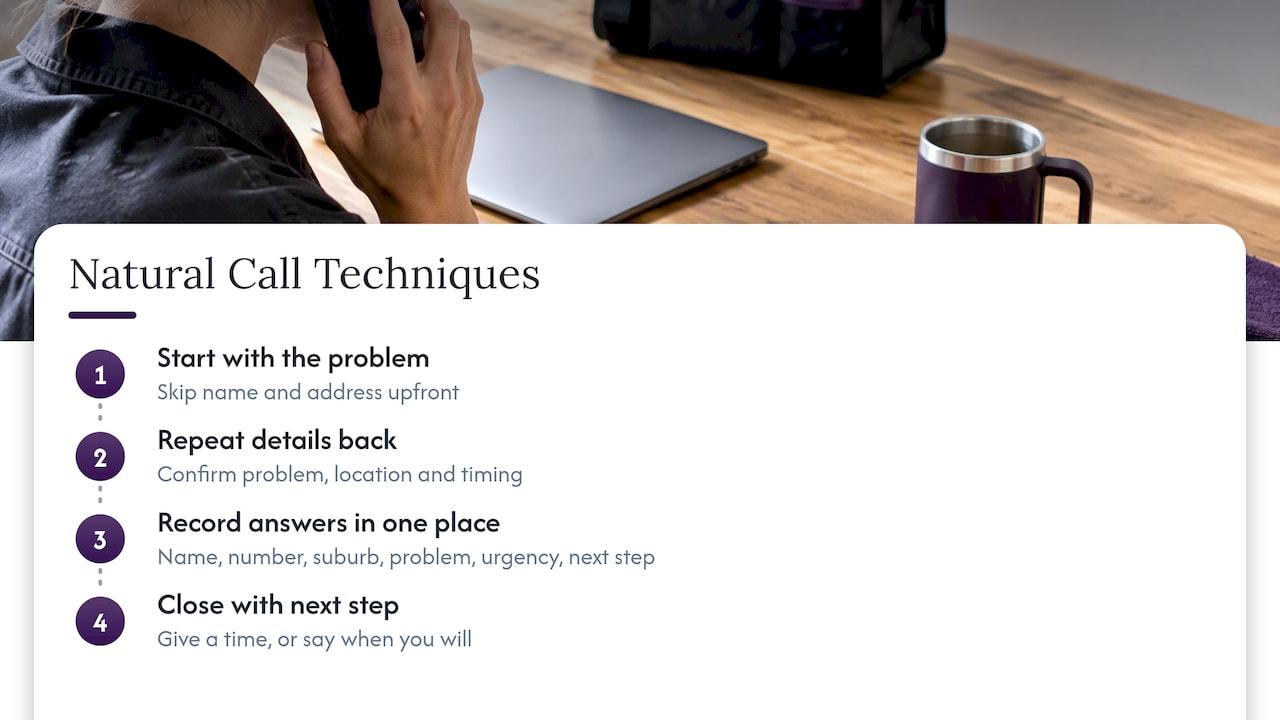
Start with the problem, not the paperwork. “What’s going on?” beats “Can I get your full name and address?”
Repeat back. “So it’s a leaking tap in the ensuite in Parramatta, and you’d like it done this week. Have I got that right?” It confirms the details and shows you listened.
Write the answers where you will actually find them. A scrap of paper on the dashboard is not a system. Whatever you use, put the name, number, suburb, problem, urgency and next step in one place.
Close with the next step and a time. The customer should hang up knowing what happens and when. If you can’t give a time, say when you will.
If you want ready-made wording for the first 20 seconds of a call, our phone answering scripts are built for tradies who answer between jobs.
What about the calls you can’t answer?
You can’t ask intake questions on a call you miss. And when you’re on a ladder, a missed call is the norm, not the exception.
Industry guidance is blunt on this: people calling from offices or during busy workdays often move on from businesses that don’t have a professional way to capture their details, and a cold “SMS your number” prompt with no human touch can feel impersonal. A warm, clear message does a lot of work.
You have a few options, from simplest to most capable:
- A good voicemail. Say who you are, what you do, which areas you cover, and ask for name, number, suburb and a one-line description. See these voicemail scripts for Australian tradies for wording you can borrow.
- A follow-up routine. Return missed calls within a set window and have a text ready. Our guide to missed call recovery covers how to do this without adding to your evenings.
- Someone or something that answers for you. A receptionist, a call-answering service or an AI assistant that asks your intake questions and passes you the answers.
The point of all three is the same: the caller gets asked the right questions, even when you’re busy.
Intake on your website
A web enquiry form should use the same short list, not a longer one. Every extra field costs you completed enquiries.
A sensible tradie form has:
- Name
- Mobile number
- Suburb or postcode
- A text box for “What do you need done?”
- An optional photo upload
- A short privacy note with a link to your policy
Make the phone number clickable on mobile and put it above the form. Plenty of customers would rather call. For layout ideas, see these homepage layouts for tradies that put the call and the enquiry first.
Our view: intake should happen where you work
We built Ask Hayley around one observation: tradies don’t sit at desks. You’re on site, hands full, and the phone rings. Forms and dashboards don’t suit that, so intake gets skipped, done late or scribbled on a hand.
Our view is that intake should work by voice. Hayley answers inbound calls when you can’t, and pre-qualifies leads before they land in your inbox, so you see a lead that already has the basics rather than a missed call and a mystery number. You can also manage day-to-day admin by talking, without learning another app.
Whatever tool you use, we’d give you the same advice. Keep the question list short. Ask what changes the job. Be warm on the phone. Collect only what you need. And never let a good lead go cold because nobody asked the right questions at the right moment.
If you want to see how we approach the question set itself, our guide to lead prequalification by voice walks through it.
— Hayley
Where Ask Hayley fits
If you’re losing jobs to missed calls or messy notes, Ask Hayley is a voice-first platform made for Australian tradies and small service businesses. It answers calls you can’t, qualifies leads, and handles admin through simple voice prompts. Plans are Assistant and Office Manager, with optional add-ons including an AI Sales Agent and an AI Website Chatbot for wider coverage of calls, leads and enquiries.
A simple intake checklist to copy
Print this, stick it in the ute or put it in your phone notes.
- Name and mobile
- Suburb or postcode (in your area? If not, say so now)
- What’s the problem or job, in their words
- Urgency: now, this week, or flexible
- Access issues: gates, pets, strata, storeys
- One or two trade-specific questions
- Propose two times, confirm the next step
- Tell them how you’ll use their details
If you can run through that in under two minutes, you have a repeatable intake.
FAQ
What questions should be included in a customer intake form?
Keep it to name, mobile, suburb, a description of the job, urgency and a preferred time. Add one or two trade-specific questions only if they change the price or the equipment. Everything else can be collected once the customer agrees to a visit or quote.
What is a customer intake?
It’s the first structured exchange with a new enquiry, by phone, web form, text or message. Its purpose is to qualify the job and agree on the next step, not to build a full customer file.
What questions should I ask in an intake call?
Start with who they are and where the job is, then let them describe the problem. Ask how urgent it is, whether there are access issues, and when suits them. Finish by confirming the next step and a time.
Do I need a privacy policy for customer intake?
It depends on your business. Many small businesses with annual turnover of $3,000,000 or less are outside the Privacy Act, but the OAIC recommends following the APPs anyway. If you’re unsure, check with your accountant or a lawyer, and tell customers in plain words why you collect their details.
Sources
- Small business | OAIC
- Chapter 3: APP 3 Collection of solicited personal information | OAIC
- Protecting customers’ personal information | OAIC
- Protect your customers’ information | business.gov.au
- Service Central provider guide


