


For most one-to-ten-person trade businesses, an AI receptionist covers what a human can’t: every call answered, on site, after hours and on weekends, at a fraction of the cost of a wage. A human still wins when a caller is upset, the job is complicated or the relationship needs a personal touch. The best setup for many tradies is a mix: AI takes the first call, and you or your office person handle what needs judgement.
This guide compares the two on the things that matter when you’re up a ladder or under a sink: missed calls, cost, call quality, privacy and legal duties in Australia, and how to start without wrecking your reputation.
TL;DR
- A full-time human receptionist costs at least the award wage, and only covers the hours they work. AI answers around the clock.
- Humans are better with distressed callers, messy scope and sales relationships. AI is better at consistency, speed and never missing a call.
- Australian privacy and consumer law already apply to AI call handling. Tell callers when they’re talking to AI.
- For most small trades, a hybrid works: AI answers and qualifies, you or your office person close the job.
- Start with the calls you currently miss, not the calls you already answer well.
Table of Contents
- The real problem: calls you can’t answer
- What a human receptionist does well
- Where a human receptionist falls short for a tradie
- What an AI receptionist does well
- Where AI falls short
- Side by side
- Australian rules you can’t ignore
- You’re not alone: AI use is growing
- Perspective: what we see at Ask Hayley
- Which is right for your trade?
- How to test either option without risk
- Where Ask Hayley fits
- FAQ
- Sources
The real problem: calls you can’t answer
You can’t answer the phone with a hand on a switchboard or a chainsaw. So the real question isn’t whether AI sounds as good as a person. It’s whether a caller reaches anyone at all.
A caller with a burst pipe or a dead switchboard usually rings the next business on the list. If you’re on a job and the call goes to voicemail, you’ve probably lost it. That’s the gap a receptionist, human or AI, is meant to close.
So compare the options against that gap, not against an imaginary perfect receptionist.
What a human receptionist does well
A good human receptionist is hard to beat in some situations.
- Reading a caller. A person hears panic, grief after storm damage or frustration with a previous tradie, and adjusts without being told to.
- Handling the unexpected. A strange request, a caller who can’t explain what’s wrong, or a question outside any script. A person improvises.
- Building relationships. Property managers, builders and repeat commercial clients like talking to someone who knows them.
- Doing the extras. Chasing a supplier, greeting someone at the door, sorting the paperwork pile, tidying the ute schedule.
There’s a research angle here too. A study on service work found the strongest results come when technology augments service employees rather than simply replacing them, for example by helping staff manage customer emotions in real time. The takeaway for a small business: AI works best alongside people.
Where a human receptionist falls short for a tradie
Cost and cover
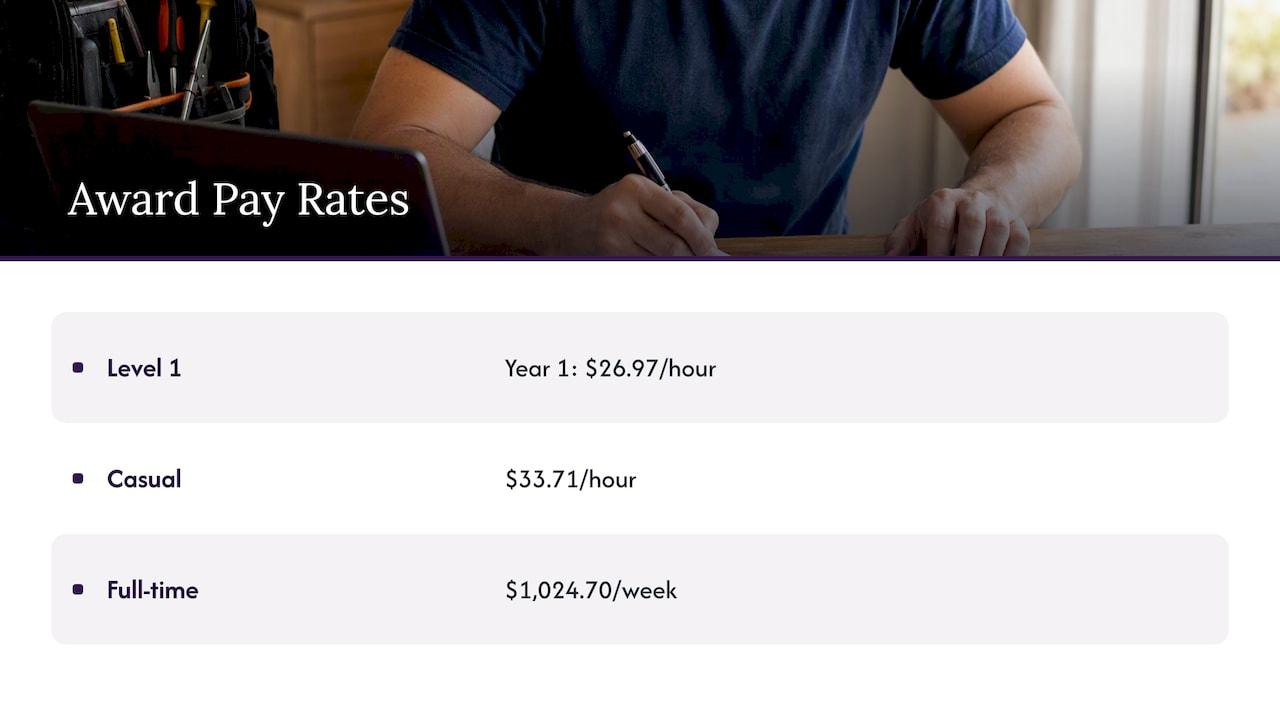
The cheapest way to hire is not that cheap. The Clerks Private Sector Award is the common starting point for office staff. One pay-rate breakdown based on the Fair Work Ombudsman’s 2026 pay guide lists Level 1, Year 1 at $26.97 an hour, or $33.71 as a casual, and $1,024.70 a week full time. Your actual classification will depend on the role, so check the Fair Work pay guide for your situation before you budget.
That’s before superannuation, leave, equipment, training and the days they’re sick. And a single person covers one shift. Evenings, weekends and lunchtime rushes are still exposed unless you hire more people.
Small businesses can’t staff the peaks
Trade calls come in bursts: after a storm, during a heatwave, first thing Monday. A receptionist can only be on one call at a time. A second caller hears an engaged tone or voicemail.
The wage is fixed, the call volume isn’t
Slow weeks still cost the same. For a sole trader or small crew, that’s often why a receptionist stays on the wish list instead of the payroll.
What an AI receptionist does well
- Answers every call. Day, night, public holidays, while you’re mid-job. Nobody hears voicemail.
- Asks the same questions every time. Suburb, type of job, urgency, access, photos. The consistency is the point. We cover the question set in our guide to voice triage for lead prequalification.
- Handles several callers at once. A storm doesn’t create a queue.
- Filters out noise. Sales calls and spam calls don’t need your attention. Our piece on screening spam calls safely explains how.
- Keeps working after the call. Notes, follow-ups and admin can flow from what was said, not from you typing at 9 pm.
There’s some evidence on how callers respond. A field experiment on voice AI in call centres found that voice AI can persistently reduce complaints on routine enquiries, though calls may run longer at first and some callers ask for a human while they get used to it. Plan for a short settling-in period, not instant perfection.
Where AI falls short
Be honest with yourself about these limits.
- Emotional calls. A customer whose roof just leaked into their child’s bedroom wants a person. A good AI setup recognises that and passes the call, or books an urgent call-back.
- Complex scoping. Large renovations, commercial tenders or unusual site conditions need your eyes and judgement.
- Wrong answers. Chatbots can say confident things that are false. That’s a legal issue as well as an embarrassment, covered below.
- Some callers just prefer a person. Older customers in particular may hang up on a machine. Offer a clear way to reach you.
Side by side
| Question | Human receptionist | AI receptionist |
|---|---|---|
| Hours covered | The shift they work | Around the clock |
| Simultaneous calls | One at a time | Many |
| Cost behaviour | Fixed wage, plus on-costs | Subscription, set by plan |
| Distressed callers | Strong | Needs a handoff to you |
| Consistency of questions | Varies with the day | Same every call |
| Complex or sales conversations | Strong | Best handed over |
| Admin after the call | Manual | Can be automated |
| Sick days, holidays | Need cover | None |
| Privacy and disclosure duties | Apply | Apply, with extra AI disclosure expectations |
Neither column wins everywhere. That’s why the decision is about what your business actually needs.
Australian rules you can’t ignore
This is the part many comparison pages skip. If an AI is answering your phone, you’re using AI with your customers’ personal information, and Australian law applies.
Privacy
The OAIC’s guidance on commercially available AI products says privacy obligations apply to personal information put into an AI system and to the output it generates. It also says organisations should be clear when external users are dealing with an AI tool such as a chatbot. The same guidance notes that from 10 December 2026, a privacy policy must disclose where a computer program uses personal information to make decisions that could significantly affect a person’s rights or interests. Most tradie call-handling won’t reach that threshold, but check your own setup, and update your privacy policy if you’re covered. If you’re unsure, ask your accountant or a privacy lawyer. For the practical side, see our note on CRM and voice updates to check before December.
Consumer law
The ACCC has said existing consumer law already applies to AI, and flagged the risk of chatbots giving false but authoritative-sounding information that can mislead consumers and small businesses. In practice: don’t let AI quote fixed prices, promise arrival times or state warranty terms unless you’ve told it exactly what to say. Tell callers it’s an AI, and give them an easy path to a person.
The “we’re already doing it safely” trap
According to the Minister for Industry and Science, a 2024 index found that 78% of businesses believed they used AI responsibly, but only 29% actually did. The government has also released a Voluntary AI Safety Standard. A short checklist beats good intentions: who sees the call recordings, what the AI is allowed to say, what it does when unsure. If you want a broader read on managing AI risks and building trust with customers, start with how your tools disclose themselves.
You’re not alone: AI use is growing
The ABS reports that around 12% of Australian businesses used AI in 2024–25, with higher uptake among innovation-active businesses. So you wouldn’t be an outlier, but you wouldn’t be following the crowd either. There’s room to get a head start on competitors who still send callers to voicemail.
Perspective: what we see at Ask Hayley
We built Ask Hayley around one idea: tradies shouldn’t need another screen. Hayley answers inbound calls when you can’t, pre-qualifies leads before they reach your inbox, and handles day-to-day admin through voice prompts.
So we don’t see this as AI versus a human. We see it as who should do which job.
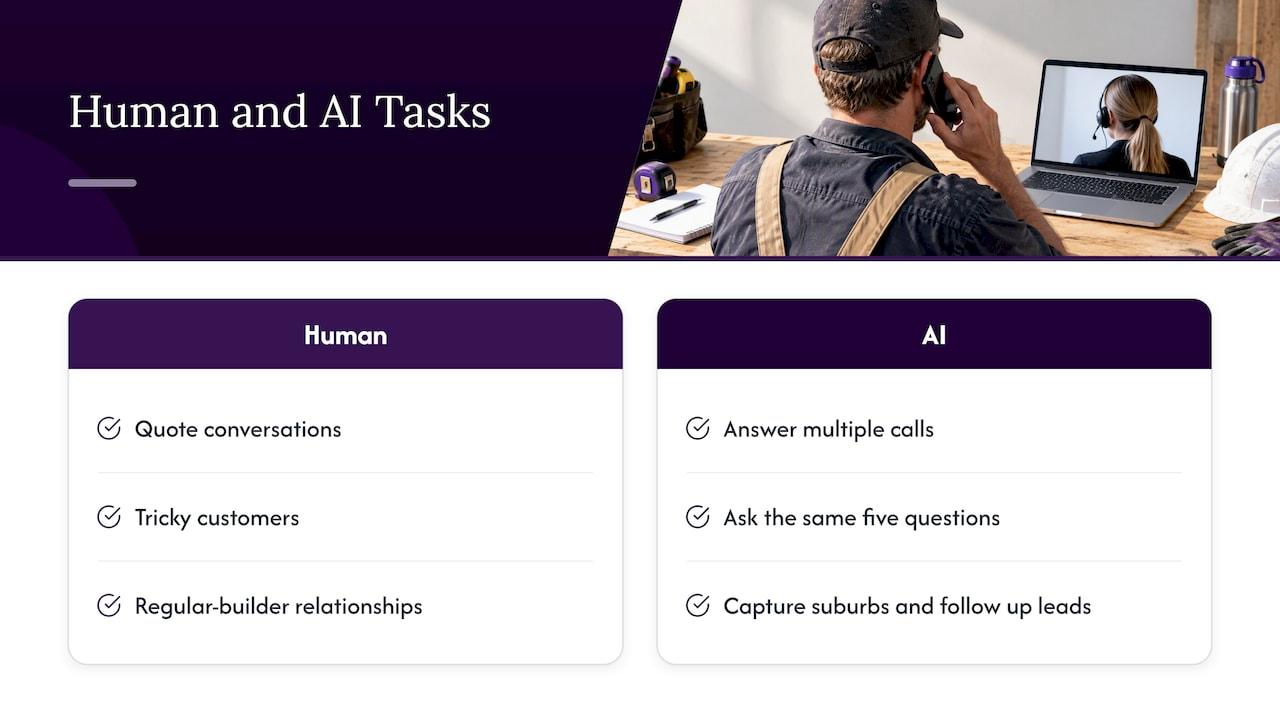
A person should do the work that needs trust, judgement and warmth: the quote conversation, the tricky customer, the relationship with a regular builder. AI should do the work that goes wrong when you’re busy: answering the third call in ten minutes, asking the same five questions, writing down the suburb correctly, following up the lead you forgot about.
We’d also say this: if your phone is already answered well by a person in the office, don’t rip that out. Add AI for overflow and after hours first. Then see what you still need. Plenty of owners find that the office person gets time back to do better work.
And tell callers who they’re talking to. It’s the law’s direction, and it’s also just good business. People forgive a machine that’s honest far more than one that pretends.
— Hayley
Which is right for your trade?
A few common situations.
Sole trader or two-person crew
You’re on the tools all day. A wage doesn’t make sense, but missed calls hurt. AI first, with a clear route to reach you for urgent jobs.
A growing business with an office person
Keep your person for customers, scheduling and suppliers. Let AI take overflow, after-hours calls and first-pass qualification. Our guide on follow-up cadence helps you decide what happens after the first call.
Emergency trades
Plumbers, electricians and glaziers get urgent, emotional calls. AI should triage: is it an emergency, is anyone at risk, what’s the address? Anything involving safety goes to a person right away. Have a written rule for what counts.
Project trades
Builders, roofers, concretors and pool builders get fewer but higher-value enquiries. A human voice on the quote matters more, so use AI to capture details and book the conversation.
How to test either option without risk
- Count your missed calls for two weeks. Note time, day and whether they left a message.
- Write your must-ask questions. Suburb, job type, urgency, access, contact details, budget range if relevant.
- Decide what triggers a handover. Distressed callers, safety, large jobs, returning customers.
- Write a disclosure line. Something like: “You’re speaking with an AI assistant for the business.”
- Check the privacy side. Where recordings go, who sees them, how long they’re kept.
- Review the first 20 calls. Listen to them. Fix the scripts, then widen the rollout.
- Measure jobs booked, not calls answered. That’s the number that pays you.
The same steps work if you’re hiring a person. You’d just be paying for the training hours too.
Where Ask Hayley fits
If you’d like AI answering your calls without learning a new dashboard, Ask Hayley is built for exactly that. It comes in two plans, Assistant and Office Manager, with an optional AI Sales Agent and AI Website Chatbot if you want wider coverage across calls and enquiries. It connects with tools like Xero and AroFlo, and you run it by talking. See how it all fits together at Ask Hayley.
And if callers also land on your website, we can help there too. Our One Page Website service is designed to turn a visitor into a phone call or an enquiry, and our guide to tradie homepage layouts shows what we’d put on it.
FAQ
Can an AI receptionist fully replace a human?
For answering, qualifying and logging calls, often yes. For difficult conversations, complex quotes and relationship work, no. Most small trade businesses do best by using AI for the first touch and keeping a person for the close.
Do I have to tell callers they’re talking to AI?
The OAIC expects organisations to be clear when people are dealing with an AI tool such as a chatbot, and consumer law bans misleading conduct. Telling callers up front is the safe approach. Check your own situation with a privacy adviser if you handle sensitive information.
Will customers hang up on an AI?
Some will, especially at first. Research on voice AI found callers may ask for a human more often while they adjust, then complaints on routine matters fall over time. A friendly opening line and an obvious way to reach you reduce hang-ups.
How much does a human receptionist cost compared with AI?
A human is paid at least the relevant award rate, which for Clerks Award Level 1, Year 1 is $26.97 an hour in the 2026 pay guide figures, plus on-costs. AI is usually a subscription. Compare your own plan price against the hours you actually need covered.
Is a chatbot the same as an AI receptionist?
Not quite. A chatbot works on your website through text, while an AI receptionist answers phone calls by voice. We compare the two in our guide to live chat versus a chatbot.
Sources
- Business adoption of AI accelerates in 2024–25, Australian Bureau of Statistics
- Guidance on privacy and the use of commercially available AI products, OAIC
- DP-REG submission to the Senate Select Committee on Adopting AI, ACCC
- Aussie businesses need more guidance on safe AI adoption, Minister for Industry and Science
- Half human, half machine: augmenting service employees with AI
- Voice-based AI in call center customer service: a natural field experiment
- Clerks Award pay rates 2026-27 (MA000002)


